
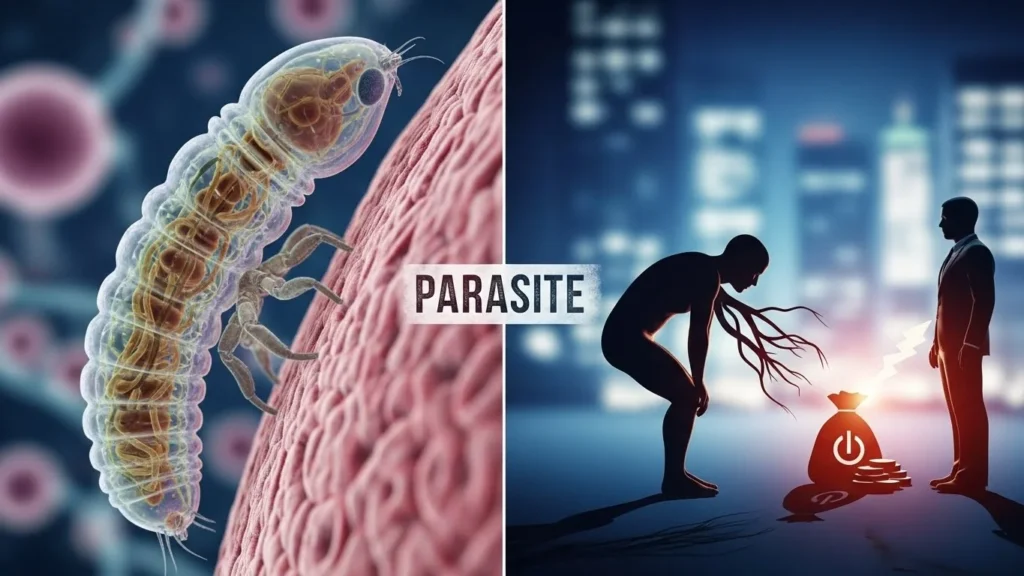

What Does “Parasite” Mean?
A parasite is an organism or entity that lives on or inside another organism (the host) and benefits at the host’s expense.
The term can also be used figuratively to describe people or behaviors that rely unfairly on others.
Parasite Meaning in Biology
In biology, a parasite is a living organism that depends on a host for survival.
Key Characteristics
Lives on or inside a host
Takes nutrients or resources
Usually causes harm or discomfort to the host
Common Biological Parasites
Tapeworms – live in intestines
Lice – live on the scalp
Mosquitoes – feed on blood (temporary parasites)
Ticks – attach to skin and feed
Types of Parasites
Endoparasites
Live inside the host
Examples: tapeworms, roundworms
Ectoparasites
Live on the surface of the host
Examples: fleas, lice, ticks
Temporary Parasites
Only visit the host briefly
Example: mosquitoes
Parasite Meaning in Everyday Language
Outside of biology, parasite is often used figuratively.
Figurative Meaning
A parasite can describe a person who depends on others for support while giving little or nothing in return.
Example:
“He lives off others without contributing—people call him a parasite.”
This usage is informal and often insulting, so it should be used carefully.
Real-Life Examples
Example 1 (Biology):
Sentence: “Malaria is caused by a parasite transmitted by mosquitoes.”
Explanation: Refers to a biological organism causing disease.
Example 2 (Everyday Speech):
Sentence: “She felt he was acting like a parasite, relying on her financially.”
Explanation: Figurative use, implying unfair dependence.
Example 3 (Science Context):
Sentence: “Parasites evolve to survive by adapting to their hosts.”
Explanation: Neutral, scientific usage.
Common Mistakes & Misunderstandings
Assuming parasite always means a worm: Parasites include insects, microorganisms, and more.
Using the word casually about people: It can be offensive if used carelessly.
Confusing parasites with bacteria or viruses: Parasites are living organisms, unlike viruses.
Tip: Check the context—scientific or figurative—before using the word.
Related Words & Concepts
Host – organism that supports a parasite
Symbiosis – close relationship between organisms
Mutualism – both organisms benefit
Commensalism – one benefits, the other is unaffected
Infection – invasion by parasites or microbes
Internal Linking Opportunity: Could link to articles like host meaning, symbiosis explained, or infection meaning.