
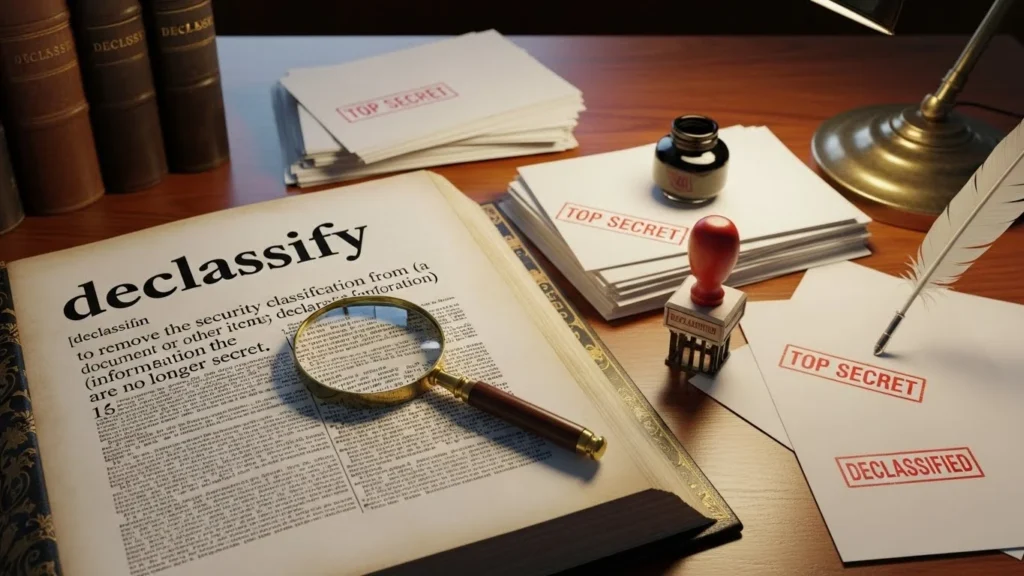

What Does “Declassify” Mean?
Declassify means to remove an official secrecy label from information, making it available to the public.
In simple terms:
Classified information = secret or restricted
Declassified information = no longer secret
Once something is declassified, people are legally allowed to see, read, or discuss it.
Declassify Meaning Explained Simply
The declassify meaning refers to the official act of making previously secret information public.
This usually applies to:
Government documents
Military records
Intelligence files
Historical reports
Example:
“A government agency decided to declassify old war documents.”
Where the Term “Declassify” Is Commonly Used
Government and Politics
This is the most common context. Governments classify information to protect national security, and later may declassify it when the risk is gone.
Intelligence reports
Diplomatic communications
National security files
Military and Intelligence
Military plans, missions, and operations may be declassified years later to allow historical review.
History and Research
Historians rely on declassified documents to understand past events more accurately.
Media and News
News outlets often report when sensitive files are officially declassified, especially if they reveal new information.
How the Declassification Process Works
While processes vary by country, declassification usually involves:
Reviewing the document
Evaluating security risks
Redacting sensitive sections if needed
Official approval by authorized officials
Public release
Not all information is released fully—some parts may remain hidden.
Who Can Declassify Information?
Only authorized individuals or institutions can declassify documents, such as:
Government agencies
High-ranking officials
National security departments
Intelligence authorities
Private individuals cannot legally declassify classified material on their own.
Real-Life Examples of “Declassify”
Example 1 (History):
Sentence: “The government declassified Cold War documents after 50 years.”
Meaning: Old secrets were made public for historical understanding.
Example 2 (News):
Sentence: “New evidence emerged after officials declassified the files.”
Meaning: The public gained access to previously hidden information.
Example 3 (General Use):
Sentence: “The archive declassified its records for academic research.”
Meaning: Restricted records became accessible.
Common Misunderstandings
Declassify ≠ leak: Declassification is legal; leaks are not.
Not instant: Declassification often takes years or decades.
Not everything becomes public: Some content may stay redacted.
Tip: If information is truly declassified, its release is officially announced or documented.
Related Words and Terms
Classified: Officially secret information
Confidential: Lower level of classification
Top Secret: Highest level of restricted access
Redacted: Parts removed or hidden
Disclosure: Making information known
Internal Linking Opportunity: Could link to articles like classified meaning, redacted meaning, or disclosure meaning.
Why Declassification Matters
Declassification helps with:
Transparency
Historical accuracy
Public accountability
Academic research
It allows societies to understand past decisions and learn from them.