

😎 Firm Meaning Slang
- In slang, “firm” can mean good, strong, or excellent
- Example: “That outfit is firm.”
- Sometimes used to describe confidence or reliability
- Popular in British slang
- Can mean something is solid or impressive
- Informal expression
- Used in casual conversations
- Meaning depends on context
- Not common in all countries
- A modern slang usage
💼 Firm Meaning in Business
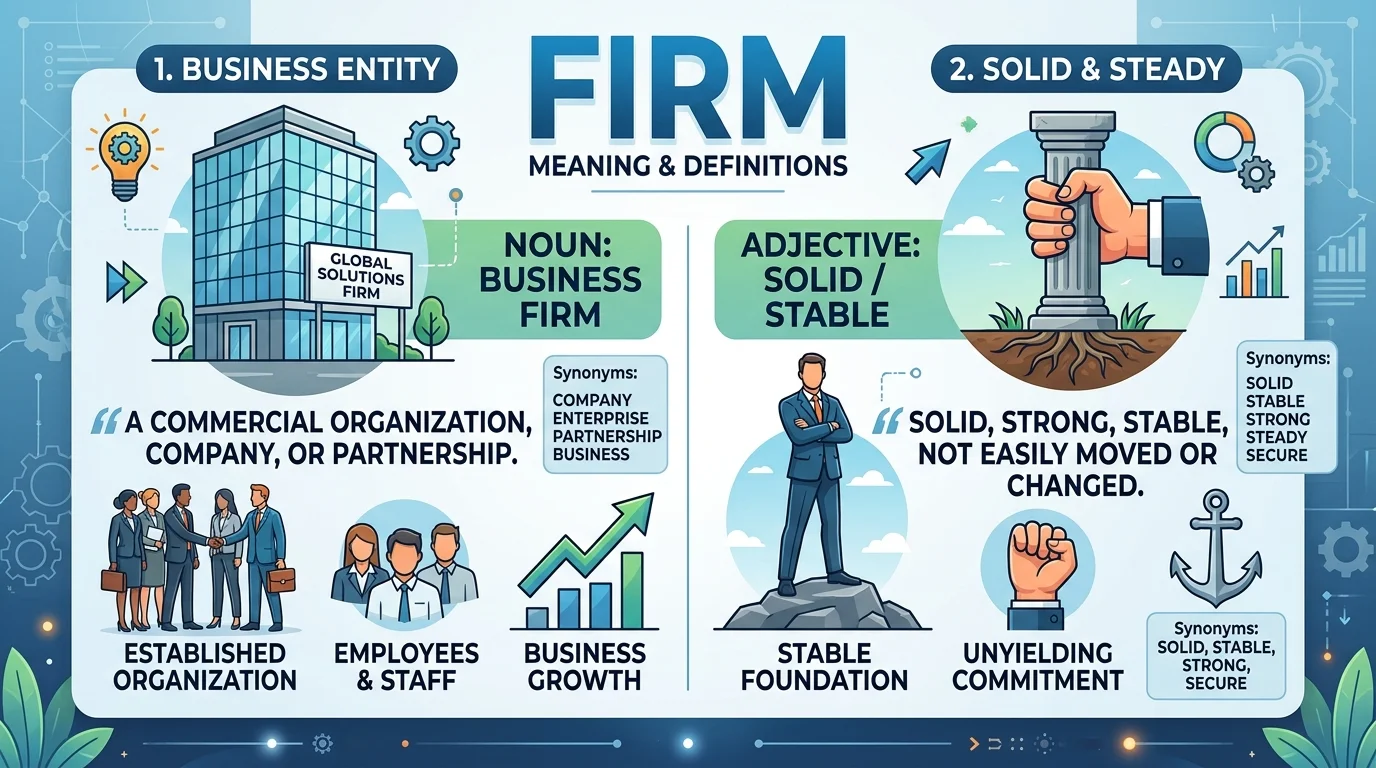
- In business, a firm is a company or business organization
- Example: law firm or accounting firm
- Provides goods or services
- Can be small or large
- Operates for profit
- Common in economics and management
- Includes partnerships and corporations
- A formal business term
- Used worldwide
- Important commercial concept
📈 Firm Meaning in Economics
- In economics, a firm is an entity that produces goods or services
- Main goal is usually profit
- Uses labor and resources
- Part of market systems
- Makes production decisions
- Can compete with other firms
- Important in microeconomics
- Studies supply and demand behavior
- Includes private and public businesses
- A core economic concept
💼 Firm Meaning in Job
- In job context, firm usually means a workplace or employer company
- Example: “She works at a law firm.”
- Refers to professional organizations
- Common in office jobs
- Used in corporate environments
- May describe stable employment
- Often linked with professional services
- A formal workplace term
- Easy to understand
- Common in career discussions
🧬 Firm Meaning in Biology
- In biology, firm means solid or not soft
- Used to describe tissues or body structures
- Example: firm muscles or firm skin
- Indicates strength or stability
- Common in medical and scientific descriptions
- Opposite of soft or weak
- Used in plant and animal biology
- Helps describe texture
- A descriptive scientific term
- Context-based meaning
📘 Firm Meaning in English
- Firm means strong, solid, steady, or strict
- Can describe objects, decisions, or people
- Example: “a firm handshake”
- Also means a business company
- Used as noun and adjective
- Common in everyday English
- Suggests stability and confidence
- Widely used word
- Has multiple meanings
- Easy to understand
👩 “She is Firm” Meaning
- “She is firm” means she is strong, confident, or strict in her decisions
- Example: firm personality or firm attitude
- Suggests determination
- Can mean emotionally steady
- Often positive description
- Used in personal and professional context
- Indicates self-control
- Opposite of weak or uncertain
- A character-related expression
- Common in spoken English
⚖️ Firm Meaning in Law
- In law, a firm usually means a group of lawyers working together
- Example: law firm
- Provides legal services to clients
- Can specialize in different legal areas
- Operates as a business organization
- Common in legal profession
- Includes partners and associates
- A formal legal term
- Used worldwide
- Important part of legal industry

What Does “Firm” Mean in Chat or Text?
In general English, firm can have multiple meanings depending on context:
-
As an adjective: Strong, solid, or steady.
-
Example: “He has a firm grip on the situation.”
-
-
As a noun (business): A company or business organization.
-
Example: “She works at a law firm.”
-
-
In casual chat/slang: Confident, decisive, or unwavering.
-
Example: “Stay firm on your decision.”
-
Origin & History
The word “firm” comes from the Latin “firmus”, meaning strong, stable, or fixed. Over centuries, it evolved in English to describe strength, stability, and reliability, both literally (like a firm object) and figuratively (like firm beliefs).
How People Use “Firm Meaning” in Real Conversations
The meaning of “firm” depends heavily on where and how it’s used. Here’s a breakdown:
Platforms
-
Texting & Messaging Apps: Friends might say “be firm” when giving advice or supporting decisions.
-
Social Media: Comments like “That’s firm!” can mean “That’s solid” or “I agree strongly.”
-
Professional Contexts: In emails or chats, “firm” often refers to a business organization.
-
Forums & Discord: Users may use “firm” to describe confidence or certainty.
Appropriate vs Awkward
-
Appropriate: Encouraging someone to be confident (“Stay firm in your choice”), describing a business (“He works at a tech firm”).
-
Awkward: Using it as slang for things unrelated to strength or confidence, which may confuse readers.

Real-Life Examples of “Firm” in Text Messages
Here are some relatable examples of how “firm” appears in everyday chats:
-
Friend A: “I’m not sure if I should say no.”
Friend B: “Just be firm, trust your gut.” -
Work Chat:
Colleague 1: “Have you contacted the law firm yet?”
Colleague 2: “Yes, they replied this morning.” -
Casual Chat:
User 1: “That argument was so solid!”
User 2: “Yeah, totally firm points.”
These examples show the versatility of “firm” in different contexts—confidence, strength, or as a company.
Common Mistakes & Misunderstandings
Even experienced chat users sometimes misuse firm:
-
Confusing it with “strong” only: While similar, “firm” can imply steadiness, not just strength.
-
Overusing in slang: “Firm” doesn’t replace all words for “cool” or “awesome.”
-
Mixing meanings: Using “firm” as slang in a business context can confuse readers.
-
Tone errors: Telling someone “be firm” without context may sound harsh.
Related Words & Slangs
Understanding related words helps clarify usage:
-
Steady: Reliable or consistent.
-
Confident: Self-assured, similar to firm in a decision context.
-
Company: Business entity, similar to “firm” as a noun.
-
Unwavering: Strongly committed, like being firm in opinion.
-
Solid: Informal synonym for strong or reliable.