
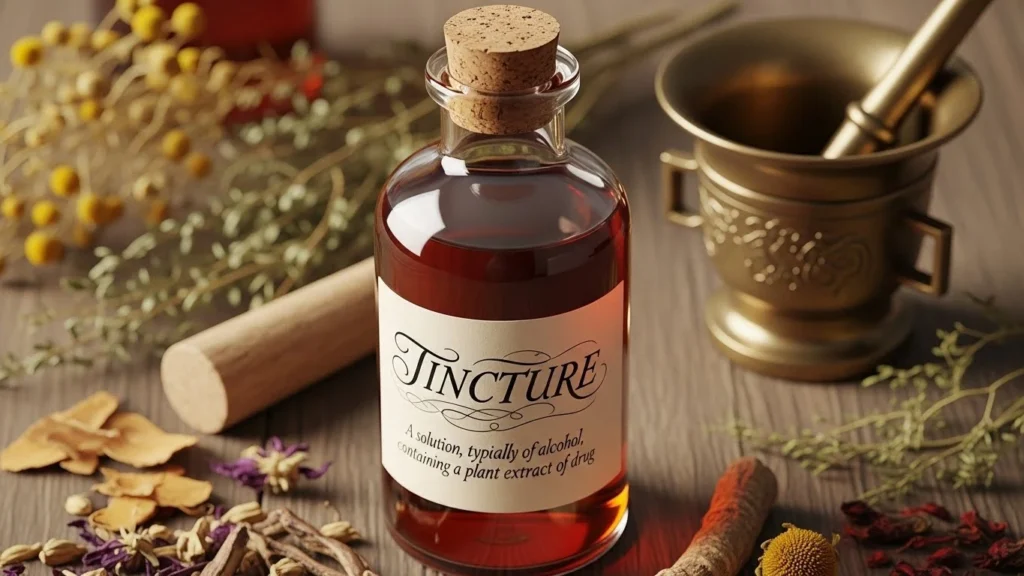

What Does “Tincture” Meaning in Chat or Text?
A tincture generally has two main meanings:
Medical or herbal context:
A tincture is a solution where a substance (usually a plant or herb) is dissolved in alcohol.
Example: “She took a tincture of echinacea for her cold.”
General or artistic context:
Tincture can mean a slight tint or color in art, design, or descriptions.
Example: “The sunset had a tincture of pink and gold.”
Origin & History
The word tincture comes from the Latin “tinctura”, meaning “a dyeing or coloring.” Historically, it referred to both medicinal solutions and coloring agents, which is why the word has dual meanings today.
How People Use “Tincture” in Real Conversations
Even outside scientific texts, tincture appears in everyday chats and online discussions.
Platforms
Texting & Messaging Apps: People might talk about herbal remedies, e.g., “Do you have a tincture for a sore throat?”
Social Media: Posts about wellness, natural remedies, or art may mention tinctures.
Forums & Discord: Health and art communities discuss tinctures in detail.
Educational Settings: Teachers or students may reference tinctures in science or art classes.
Appropriate vs Awkward
Appropriate: Talking about herbal medicine, colors, or creative design.
Awkward: Using “tincture” casually as slang in unrelated contexts—it can confuse people.
Real-Life Examples of “Tincture” in Text Messages
Here are some chat-style examples showing tincture in use:
Friend A: “I feel a cold coming on.”
Friend B: “Try a tincture of elderberry—it really helps.”Art Class Chat:
Student A: “I added a tincture of blue to my painting.”
Student B: “Nice! It gives it a soft tone.”Casual Conversation:
User 1: “The lighting gave a tincture of orange to the room.”
User 2: “Sounds warm and cozy!”
These examples show both medical and color-related uses of tincture.
Common Mistakes & Misunderstandings
Even with common usage, people can misunderstand tincture:
Confusing tincture with pill or capsule: A tincture is liquid, usually alcohol-based.
Mixing medical and color meanings: Saying “I took a tincture of pink” would be incorrect.
Overusing in casual chat: Not everyone knows this term, so context matters.
Mispronunciation or spelling errors: Sometimes spelled incorrectly as “tinctur” or “tinctre.”
Related Words & Concepts
Understanding related terms helps clarify usage:
Extract: Similar to a tincture, often used for herbs.
Infusion: Herbs steeped in water instead of alcohol.
Dye: Color-based meaning of tincture.
Herbal remedy: General category that includes tinctures.
Concentrate: Strong solution, like a tincture.