


🔄 Nuances Synonyms
- Subtleties
- Fine distinctions
- Shades
- Variations
- Details
- Refinements
- Gradations
- Hints
- Complexities
- Delicate differences
🇵🇰 Nuances Meaning in Urdu
- Nuances کا مطلب ہے باریک فرق / لطیف پہلو / نازک تفصیلات
- یہ چھوٹے مگر اہم فرق کو ظاہر کرتا ہے
- مثال: زبان کے باریک فرق
- عام طور پر ادب، گفتگو، اور فن میں استعمال ہوتا ہے
- کسی چیز کی گہری سمجھ کو ظاہر کرتا ہے
- مثبت علمی لفظ ہے
- تفصیلی معنی رکھنے والا لفظ
- جذبات یا خیالات کے معمولی فرق
- سمجھنے کے لیے توجہ ضروری ہوتی ہے
- ایک sophisticated اظہار
✍️ Nuance in a Sentence
- “She understood the nuances of the conversation.”
- “The actor captured every emotional nuance.”
- “Language has many cultural nuances.”
- “He explained the nuance of the law clearly.”
- “Good writers notice small nuances.”
- “There are nuances in human behavior.”
- “The translation missed some nuances.”
- “Music contains emotional nuances.”
- “Teachers explain nuances of grammar.”
- “Life is full of subtle nuances.”
📘 Nuances Meaning in English
- Nuances are small subtle differences or details
- Often difficult to notice immediately
- Example: emotional nuances in speech
- Used in language, art, and behavior
- Shows depth or complexity
- Common in formal English
- Helps describe fine distinctions
- Important in communication
- Used in literature and psychology
- A sophisticated vocabulary word
💡 Nuances Meaning Example
- Example: “Two words may seem similar, but their nuances are different.”
- Example: “She noticed the nuances in his tone.”
- Refers to subtle meaning changes
- Often emotional or cultural
- Important in interpretation
- Used in analysis and discussion
- Helps improve understanding
- Common in education and writing
- Indicates attention to detail
- A refined expression
👤 Nuance Person Meaning
- When describing a person, nuance means they are complex, thoughtful, or subtle in behavior or thinking
- Example: “She has a nuanced personality.”
- Suggests emotional depth
- Not simple or one-dimensional
- Often intelligent or perceptive
- Used positively in conversation
- Indicates understanding of details
- Common in psychology and literature
- Reflects sophistication
- A descriptive personality term
⚖️ Nuance Meaning in Law
- In law, nuance refers to small but important differences in meaning or interpretation
- Legal wording often depends on nuance
- Tiny changes can affect outcomes
- Important in contracts and court cases
- Used by lawyers and judges
- Helps interpret legal language accurately
- Common in legal analysis
- Indicates complexity of law
- A professional legal concept
- Critical in legal arguments
🌱 Nuances of Life Meaning
- “Nuances of life” means the small details, complexities, and subtle experiences in life
- Refers to emotional and personal differences
- Example: relationships, feelings, and choices
- Suggests life is not simple
- Common in philosophical discussions
- Used in motivational writing
- Indicates deeper understanding
- A thoughtful expression
- Reflects human experience
- Popular in literature and conversations

What Does “Nuances” Mean?
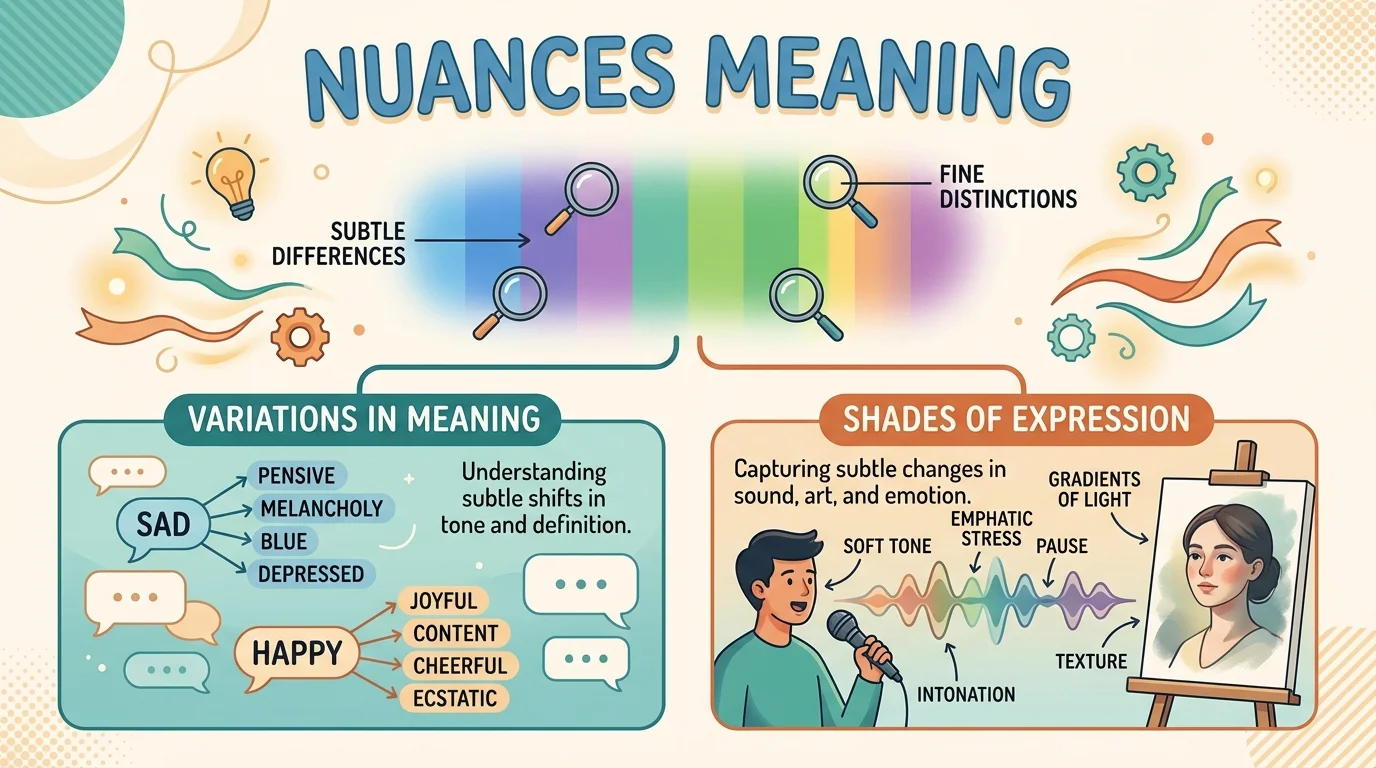
Nuances are small differences, subtle details, or slight variations in meaning, tone, or expression.
Simple definition:
Nuances are the tiny details that change how something is understood.
They are not obvious at first glance, but they matter a lot.
Examples of nuances include:
Tone of voice
Word choice
Cultural context
Body language
Emotional implication
A sentence can mean one thing on the surface and something slightly different when you notice the nuance.
Origin & Background
The word nuance comes from French, meaning “shade” or “slight difference.” Over time, it became a key word in English for describing subtle distinctions, especially in language, art, and communication.
How People Use “Nuances” in Real Conversations
Unlike slang, nuances is a common everyday word—but mostly in thoughtful or explanatory contexts.
Common Places You’ll See “Nuances”
Language learning: Explaining word differences
Writing & literature: Analyzing meaning
Work discussions: Communication clarity
Social issues: Explaining complexity
Online debates: Avoiding oversimplification
Natural vs Awkward Usage
Natural use:
Explaining complexity
Talking about communication or meaning
Describing subtle differences
Awkward use:
Casual small talk
Overusing it to sound smart
Using it without explaining the details
People usually say “nuances” when they want to show that something isn’t black and white.
Nuances Meaning in Language and Communication
In language, nuances refer to small differences in meaning between words or phrases that seem similar.
Example:
“Confident” vs “arrogant”
Same behavior, different nuance.
Another example:
“I’m fine.”
Depending on tone, it can mean:I’m okay
I’m upset
I don’t want to talk
The nuance changes the real meaning.
Real-Life Examples of “Nuances” in Sentences
Here’s how nuances is actually used in everyday English:
Example 1: Conversation
“Text messages miss a lot of emotional nuances.”
Meaning: texts don’t show tone or feelings well.
Example 2: Work Setting
“You need to understand the cultural nuances.”
Meaning: small cultural differences matter.
Example 3: Education
“The book explores the nuances of human behavior.”
Meaning: it focuses on subtle emotional details.
Example 4: Language Learning
“There are nuances between these two words.”
Meaning: they’re similar but not identical.
Why Nuances Matter So Much
Ignoring nuances often leads to:
Misunderstandings
Arguments
Miscommunication
Oversimplified thinking
Understanding nuances helps you:
Read situations better
Avoid conflict
Sound more thoughtful
This is especially important in:
Online communication
Cross-cultural conversations
Professional environments
Common Mistakes & Misunderstandings
People often misuse or misunderstand nuances.
Common Errors
Thinking nuances are big differences
They are small but important.Using the word without examples
Nuances should be explained, not just mentioned.Confusing nuance with opinion
Nuance is about detail, not preference.Using it to avoid clarity
Sometimes people say “it’s nuanced” instead of explaining.
Nuance vs Similar Words
These words are related but not identical:
Subtlety: Delicate detail
Distinction: Clear difference
Implication: Suggested meaning
Context: Surrounding information
Tone: Emotional quality
Nuance usually combines several of these at once.
Related Terms & Concepts
These words often appear with nuances:
Context: Situation or background
Interpretation: How something is understood
Perspective: Point of view
Complexity: Multiple layers of meaning
Subtext: Hidden or implied meaning
These are strong internal-linking opportunities for educational content.