🇪🇸 Ustedes meaning in English
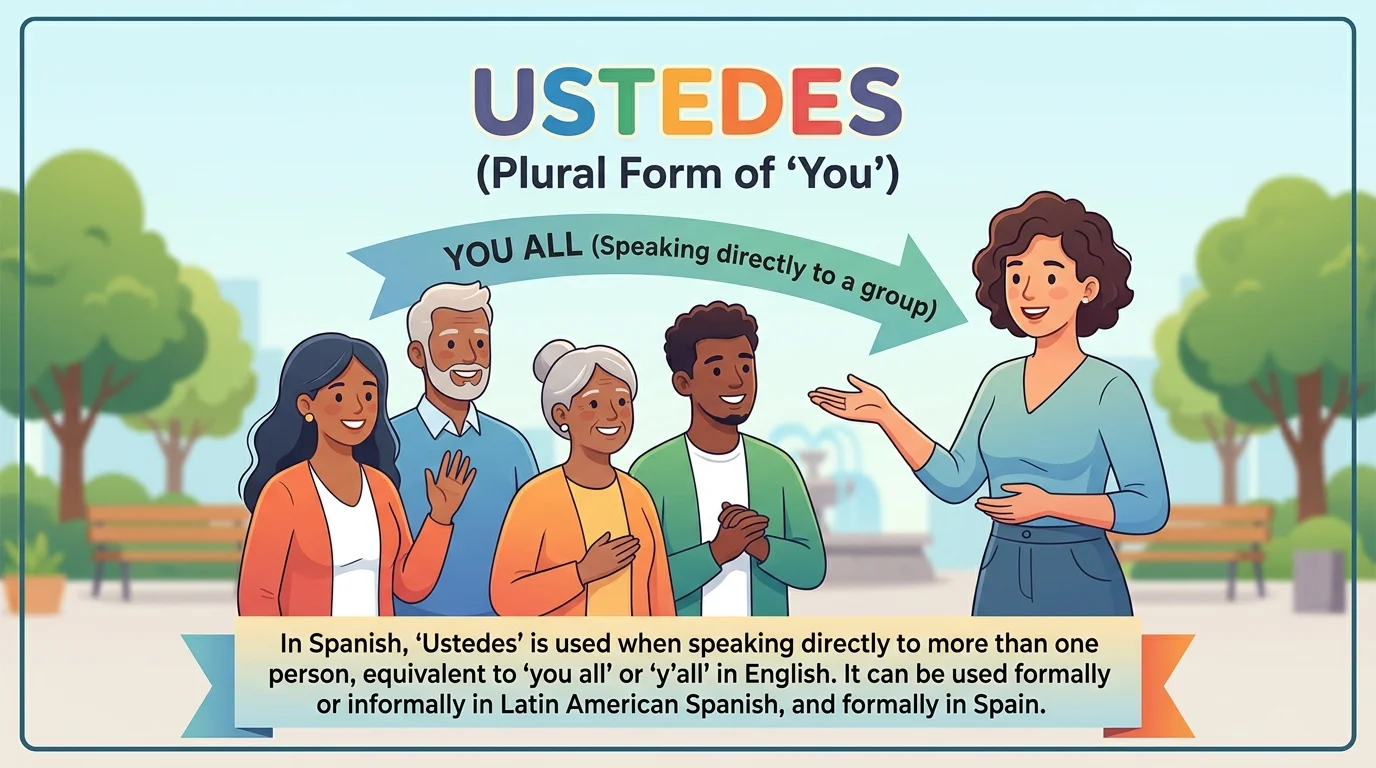
- “Ustedes” means “you” (plural) in English
- It is used when speaking to more than one person
- In many contexts, it translates as “you all” / “you guys”
- It is the standard plural “you” in Latin American Spanish
- In Spain, it is mainly used in formal situations
- It is not used for a single person
- It always refers to a group of people
- It replaces both formal and informal “you” in most Latin American countries
- It is part of everyday Spanish conversation
- Common in greetings, instructions, and conversations
👥 Does “ustedes” mean they?
- No, “ustedes” does not mean “they”
- “They” in Spanish is “ellos” (masculine/mixed group) or “ellas” (feminine group)
- “Ustedes” means “you all” (you plural)
- It refers to the people you are speaking to
- “They” refers to people you are talking about
- They are completely different grammatical subjects
- “Ustedes” = second person plural
- “Ellos/ellas” = third person plural
- Common confusion for Spanish learners
- Important distinction in Spanish grammar
🟡 Is “ustedes” formal?
- In Spain, “ustedes” is formal
- In Latin America, it is both formal and informal
- Used for groups regardless of social level in many countries
- Replaces “vosotros” in most Latin American Spanish
- Can be polite when addressing strangers
- Common in business and public speaking
- Formality depends on region
- Always safe to use in Latin America
- Not considered rude or casual
- Context decides tone, not the word itself
👥 Is “ustedes” plural?
- Yes, “ustedes” is always plural
- It refers to two or more people
- Never used for a single person
- Equivalent to “you all” or “you guys”
- Works for any group size
- Used in commands and statements
- Example: “Ustedes son amigos” = You are friends
- Very common in everyday Spanish
- One of the main plural pronouns in Spanish
- Essential part of Spanish grammar
📱 Ustedes meaning Duolingo
- On Duolingo, “ustedes” is taught as “you (plural)”
- Used when addressing multiple people in exercises
- Often appears in translation practice sentences
- Helps learners understand group communication
- Common in beginner Spanish lessons
- Usually paired with verbs like “son,” “tienen,” “van”
- Teaches difference between singular and plural “you”
- Important for Latin American Spanish track
- Helps build sentence structure skills
- Frequently used in practice quizzes
🗣️ Ustedes son in English
- “Ustedes son” means “you are” (plural)
- Used when talking to more than one person
- Example: “Ustedes son estudiantes” = You are students
- “Son” is the plural form of “are” in Spanish
- Always refers to a group
- Common in descriptions and introductions
- Used in both formal and informal contexts
- Very frequent in Spanish conversation
- Important phrase for beginners
- Helps form basic sentences
✍️ Ustedes in a sentence
- Ustedes son muy amables = You are very kind
- Ustedes tienen una casa = You have a house
- Ustedes van al parque = You all go to the park
- Ustedes estudian español = You all study Spanish
- Ustedes están felices = You are happy
- Ustedes hablan rápido = You all speak fast
- Ustedes comen pizza = You all eat pizza
- Ustedes trabajan aquí = You all work here
- Ustedes viven en la ciudad = You all live in the city
- Ustedes son mis amigos = You are my friends
⚖️ Is “ustedes” formal or informal?
- In Latin America, it is neutral (both formal and informal)
- In Spain, it is mainly formal plural “you”
- Replaces “vosotros” in Latin American Spanish
- Safe to use in any situation in Latin America
- Can be polite when speaking to groups of strangers
- Used in classrooms, workplaces, and daily life
- Tone depends on context, not grammar
- Always respectful in communication
- One of the most important Spanish pronouns
- Essential for real-world Spanish understanding

What Does “Ustedes” Meaning?
Ustedes is the formal or standard Spanish word for “you all” or “you guys” when addressing more than one person.
Key Points About Ustedes
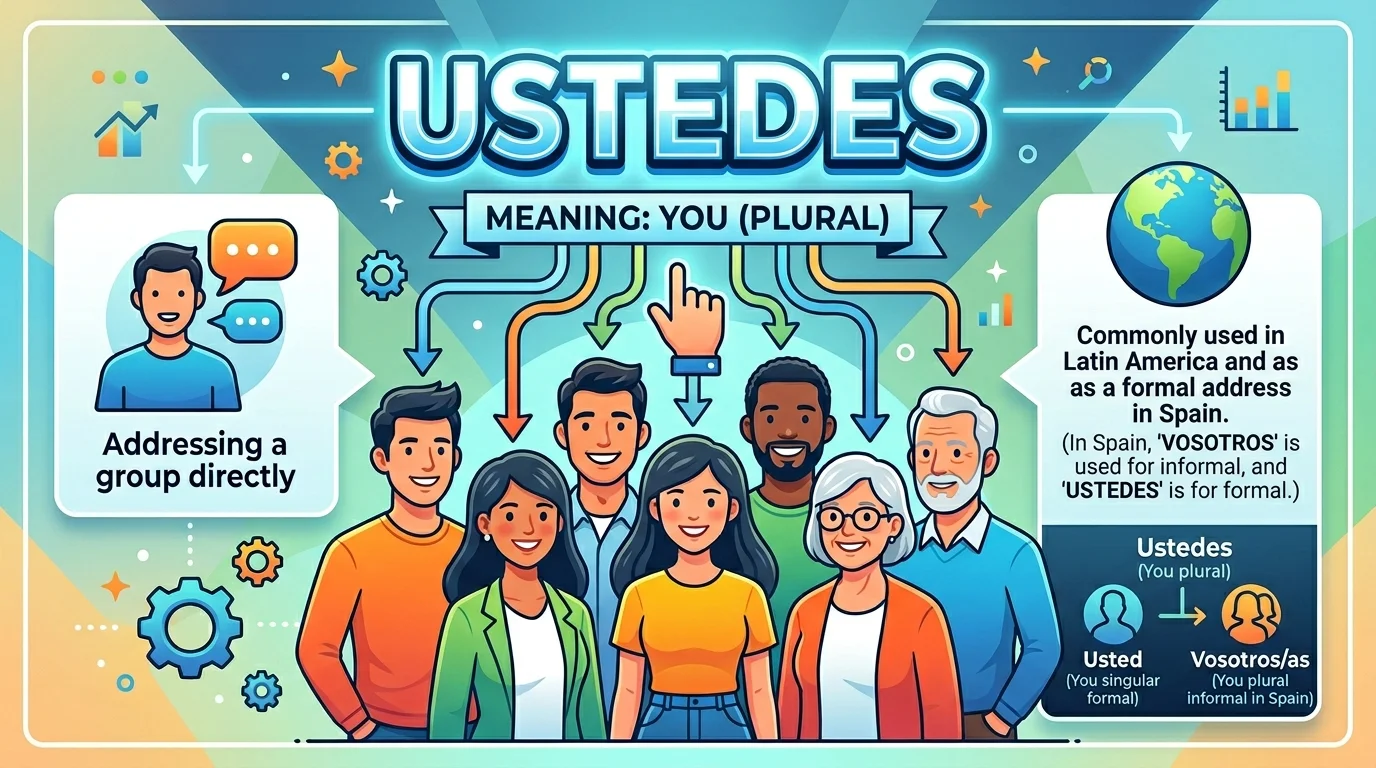
Ustedes = You (plural)
Used for addressing two or more people
Common in both formal and informal contexts in Latin America
In Spain, vosotros is used for informal situations instead
Origin of Ustedes
Comes from the phrase “Vuestras Mercedes” (your graces) in Old Spanish
Shortened over time to ustedes
Traditionally formal, but now standard in Latin American Spanish
How People Use “Ustedes” in Real Conversations
Ustedes is widely used in everyday Spanish and appears in:
Platforms and Situations
Texting and messaging apps
Classroom or school conversations
Work or business communication
Social media posts
Group discussions
When Ustedes Is Appropriate
Addressing any group of people in Latin America
Formal situations like meetings or presentations
Writing polite emails or letters
Asking questions or giving instructions to a group
When Vosotros Is Used Instead
In Spain, vosotros is used for informal situations with multiple people
Ustedes in Spain is reserved for formal situations
Real-Life Examples of “Ustedes” in Sentences
Example 1
“¿Ustedes quieren café?”
Explanation: “Do you all want coffee?” — addressing a group politely.
Example 2
“Ustedes son muy amables.”
Explanation: “You all are very kind.” — complimenting a group.
Example 3
“¿Dónde están ustedes?”
Explanation: “Where are you all?” — asking a group for their location.
Example 4
“Ustedes deben entregar el proyecto mañana.”
Explanation: “You all must submit the project tomorrow.” — giving instructions.
Example 5
“Gracias a ustedes por ayudarme.”
Explanation: “Thanks to you all for helping me.” — showing gratitude to a group.
Common Mistakes & Misunderstandings
Even beginners make mistakes when using ustedes.
Common Errors
Using ustedes for one person:
Ustedes is always plural. For one person, use usted.
Confusing usted vs ustedes:
Usted = you (singular formal)
Ustedes = you all (plural, formal in Spain, standard in Latin America)
Mixing vosotros and ustedes incorrectly:
Vosotros is informal plural in Spain; in Latin America, it’s rarely used.
Incorrect verb conjugation:
Ustedes requires third-person plural verbs, e.g., “Ustedes hablan” (You all speak).
Related Words and Concepts
Other Spanish pronouns related to ustedes:
Tú: You (singular, informal)
Usted: You (singular, formal)
Vosotros: You all (plural informal, Spain only)
Ellos/Ellas: They (male/female)
Internal linking tip: These pair well with articles like usted meaning, vosotros meaning, or tú vs usted guide.
FAQs
What does ustedes mean in English?
Ustedes means “you all” or “you guys” when addressing a group.
Is ustedes formal or informal?
In Latin America, it’s standard for all situations. In Spain, it’s formal.
How do you conjugate verbs with ustedes?
Use third-person plural verbs, e.g., “ustedes hablan” = “you all speak.”
Can I use ustedes for friends?
Yes, in Latin America, it’s common even among friends. In Spain, use vosotros for informal friends.
Is ustedes singular or plural?
Plural — always used for two or more people.