


📘 Dissertation meaning in English
- A dissertation is a long, formal piece of academic writing
- Usually written as part of a university degree
- Based on research, study, and analysis
- Common at bachelor’s, master’s, or PhD level
- Presents original ideas or findings
- Structured with introduction, methodology, results, and conclusion
- Requires academic sources and references
- Often supervised by a professor
- Very formal and detailed document
- Important requirement for graduation in many courses
🔬 Dissertation meaning in research
- In research, a dissertation is a formal research report
- Shows a student’s independent investigation
- Includes data collection and analysis
- Must follow academic research methods
- Focuses on solving a research problem
- Often includes literature review and methodology
- Can be qualitative or quantitative
- Demonstrates research skills and critical thinking
- Used to contribute new knowledge
- Key academic research output
⚖️ Dissertation vs Thesis
- Dissertation: usually for undergraduate or master’s (varies by country)
- Thesis: often for PhD-level research (in many systems)
- Dissertation is sometimes shorter than a thesis
- Thesis is generally more advanced and original
- Both are long academic research papers
- Both require supervision and defense (viva)
- Both include research methodology
- Terms can be reversed in some countries
- Both are academic qualification requirements
- Main difference depends on education system
⚖️ Dissertation meaning in law
- In law, a dissertation is a research-based legal paper
- Focuses on legal theories or case studies
- May analyze laws, judgments, or policies
- Required in law degrees (LLB/LLM/PhD)
- Includes legal arguments and references
- Must follow structured academic writing
- Often focuses on a specific legal issue
- Demonstrates legal research ability
- Can propose reforms or interpretations
- Formal academic legal document
🔁 Dissertation meaning synonym
- Thesis
- Research paper
- Academic paper
- Study report
- Scholarly work
- Final project
- Research document
- Academic dissertation (formal repetition)
- Study thesis
- Written research
🔊 DISSERTATION pronunciation
- Pronounced: dis-er-TAY-shun
- Phonetic: /ˌdɪs.ərˈteɪ.ʃən/
- Stress on “TAY” syllable
- Four syllables total
- Common academic pronunciation
- Formal English word
- Used in universities and research
- Often mispronounced as “dis-ser-ta-tion” evenly
- Clear stress improves clarity
- Standard academic vocabulary term
🏥 Dissertation meaning in medical term
- In medicine, a dissertation is a research paper in medical studies
- Required for MD, PhD, or specialization degrees
- Focuses on medical research topics
- May include clinical trials or case studies
- Uses scientific data and analysis
- Important in evidence-based medicine
- Written under academic supervision
- Must follow ethical research standards
- Can contribute to medical knowledge
- Formal academic requirement
✍️ Dissertation meaning and examples
- Dissertation = long academic research paper
- Example: a student writes a dissertation on climate change
- Example: medical dissertation on diabetes treatment
- Example: law dissertation on human rights laws
- Example: psychology dissertation on behavior patterns
- Example: engineering dissertation on AI systems
- Example: economics dissertation on inflation trends
- Example: sociology dissertation on social media effects
- Example: education dissertation on learning methods
- Example: biology dissertation on genetics
- Example: business dissertation on marketing strategies
What Is a Dissertation meaning?
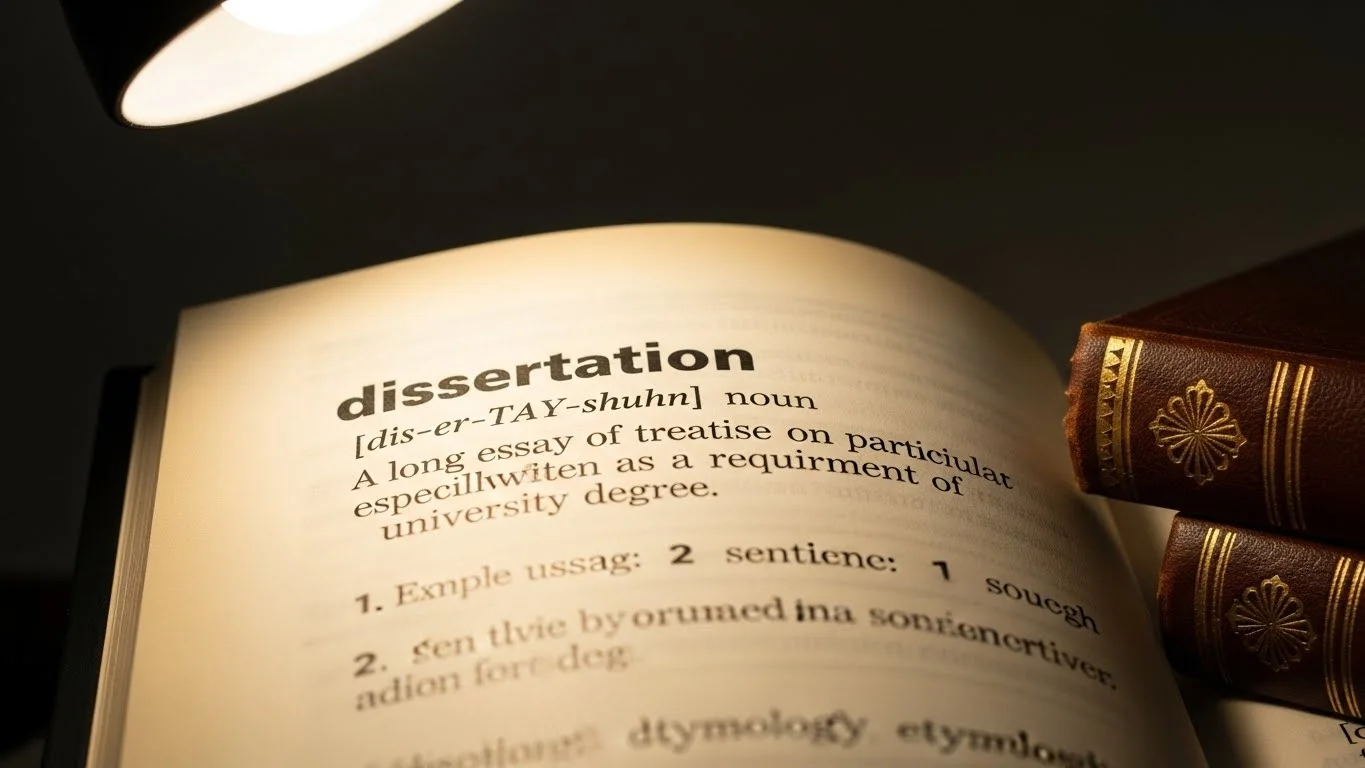
A dissertation is a long piece of academic writing based on original research. It is usually required for higher education degrees, such as a master’s or doctoral program, and demonstrates your knowledge, research skills, and ability to analyze a topic deeply.
Purpose of a Dissertation
The main purposes of a dissertation are:
-
To showcase original research and critical thinking.
-
To demonstrate mastery of your subject area.
-
To contribute new knowledge or insights to your field.
Difference Between Dissertation and Thesis
Although often used interchangeably, a dissertation and a thesis differ:
-
Dissertation: Usually for PhD or doctoral studies, more extensive, original research.
-
Thesis: Often for master’s programs, shorter, may focus on summarizing existing research.
Types of Dissertations
Common types include:
-
Empirical dissertations: Based on experiments or surveys.
-
Theoretical dissertations: Focus on theories, models, and concepts.
-
Practical dissertations: Apply knowledge to real-world problems.
Dissertation Structure
A typical dissertation includes:
-
Title page
-
Abstract – a brief summary of research
-
Introduction – overview and objectives
-
Literature review – analysis of existing studies
-
Methodology – research methods used
-
Results – findings from your research
-
Discussion – interpretation of results
-
Conclusion – summary and implications
-
References/Bibliography
Choosing a Dissertation Topic
Tips for selecting a topic:
-
Pick something you are passionate about.
-
Ensure the topic is researchable and manageable.
-
Check existing literature to avoid duplication.
-
Consider the relevance and impact of your topic.
Research Methods in Dissertations
Common research methods include:
-
Qualitative: Interviews, focus groups, observations.
-
Quantitative: Surveys, experiments, statistical analysis.
-
Mixed-methods: Combination of qualitative and quantitative.
Writing a Dissertation
Key tips:
-
Plan your research and writing ahead of time.
-
Follow a structured outline for clarity.
-
Use academic and formal language.
-
Cite sources correctly to avoid plagiarism.
Common Mistakes in Dissertations
-
Choosing a vague or overly broad topic
-
Ignoring existing research
-
Weak research methodology
-
Poor organization and structure
-
Inadequate proofreading and editing
How to Conduct Literature Review
-
Search relevant journals and books
-
Analyze and compare different studies
-
Identify gaps in research
-
Summarize findings clearly
Dissertation Timeline
-
Topic selection – 1-2 months
-
Proposal writing – 1-2 months
-
Research and data collection – 3-6 months
-
Writing dissertation – 3-4 months
-
Editing and submission – 1-2 months
Dissertation in Daily Life
-
Shows your academic and research skills
-
Helps with career opportunities
-
Develops critical thinking and analytical skills
Dissertation vs Essay
-
Dissertation: Longer, in-depth, original research
-
Essay: Shorter, focused on analysis or argument, less research
Common Terms Related to Dissertation
-
Abstract: Summary of your research
-
Methodology: The approach to your study
-
Findings/Results: What you discovered
-
Discussion: Explaining the meaning of results
-
References/Bibliography: Sources cited
Why Dissertation Is Important
-
Demonstrates your expertise
-
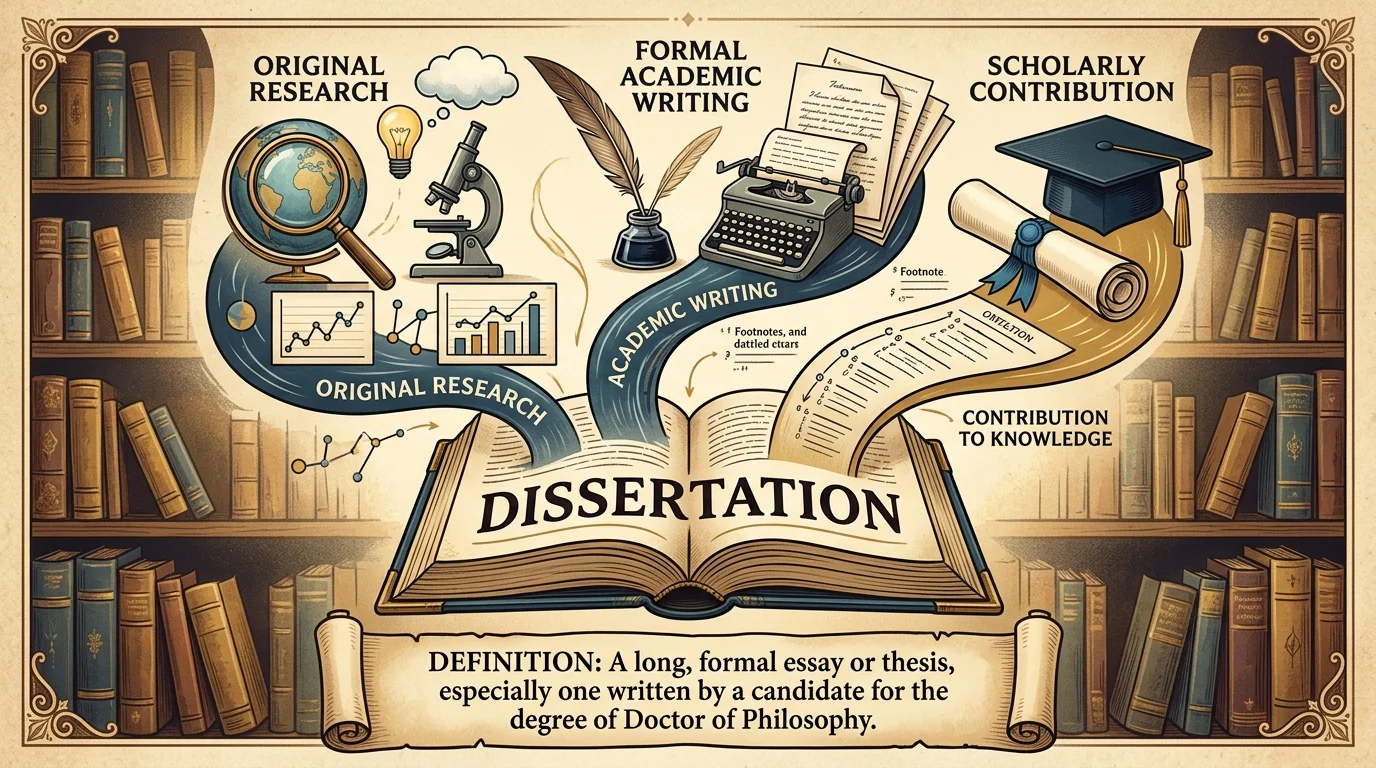
Contributes new knowledge to your field
-
Prepares you for academic or professional work
Tips for Success
-
Start early and plan carefully
-
Maintain consistent writing schedule
-
Seek feedback from advisors
-
Revise and proofread thoroughly