
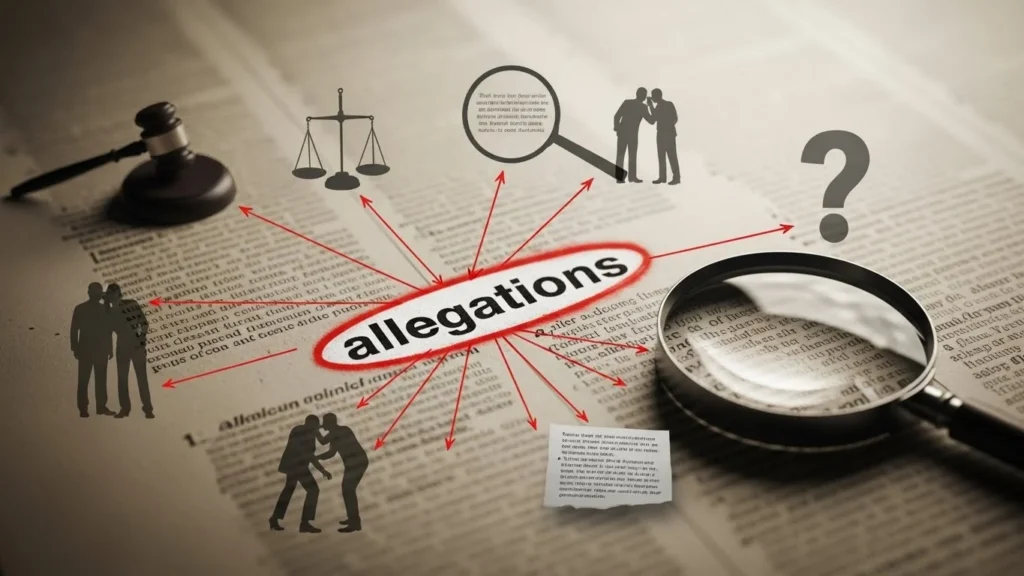

What Does “Allegations” Mean in Chat or Text?
Allegations is the plural of allegation and generally means:
Claims or accusations made against someone, often without proof initially.
Example: “There are allegations of misconduct against the manager.”
In legal contexts: Statements claiming wrongdoing that may be investigated or proven in court.
In casual conversation: Sometimes used to describe claims or suspicions about someone or something.
Origin & History
The word allegation comes from the Latin “allegatio”, meaning “assertion” or “statement made on behalf of.” Historically, it has been used in law, politics, and disputes to describe claims requiring investigation or proof.
How People Use “Allegations Meaning” in Real Conversations
Even outside legal texts, allegations appears in everyday chat and social media.
Platforms
Texting & Messaging Apps: “There are allegations that our neighbor is not following the rules.”
Social Media: News about public figures or organizations often report allegations before confirmation.
Forums & Discord: Discussing workplace or school situations where claims are made.
Professional & Legal Contexts: Lawyers, HR professionals, or journalists use allegations when reporting claims.
Appropriate vs Awkward
Appropriate: Talking about accusations, claims, or disputes.
Awkward: Using it casually for trivial complaints (“There are allegations my cat ignored me”) — it can sound exaggerated.
Real-Life Examples of “Allegations” in Text Messages
Here are some relatable examples showing how “allegations” appears in conversations:
Friend A: “Did you hear about the new company CEO?”
Friend B: “Yes, there are allegations of financial misconduct.”Work Chat:
Colleague 1: “Some allegations came up regarding overtime policies.”
Colleague 2: “HR will probably investigate them.”Casual Chat:
User 1: “There are allegations that Alex cheated in the game.”
User 2: “Really? I hope someone checks the scores properly.”
These examples show allegations in legal, workplace, and casual contexts.
Common Mistakes & Misunderstandings
Even experienced speakers and writers sometimes misuse allegations:
Confusing allegations with proven facts: Allegations are claims that may or may not be true.
Overusing in casual chat: Using it for minor complaints can seem overly dramatic.
Mispronunciation or spelling errors: Sometimes spelled incorrectly as “allegences” or “allegationss.”
Mixing it with complaints: Complaints are expressions of dissatisfaction, but allegations imply claims of wrongdoing.
Related Words & Concepts
Understanding related terms helps clarify usage:
Accusation: A direct claim that someone did something wrong.
Claim: A statement that something is true.
Charge: Often used in legal contexts to formally accuse someone.
Complaint: Expression of dissatisfaction, less formal than allegations.
Investigation: Process to check if allegations are true.