
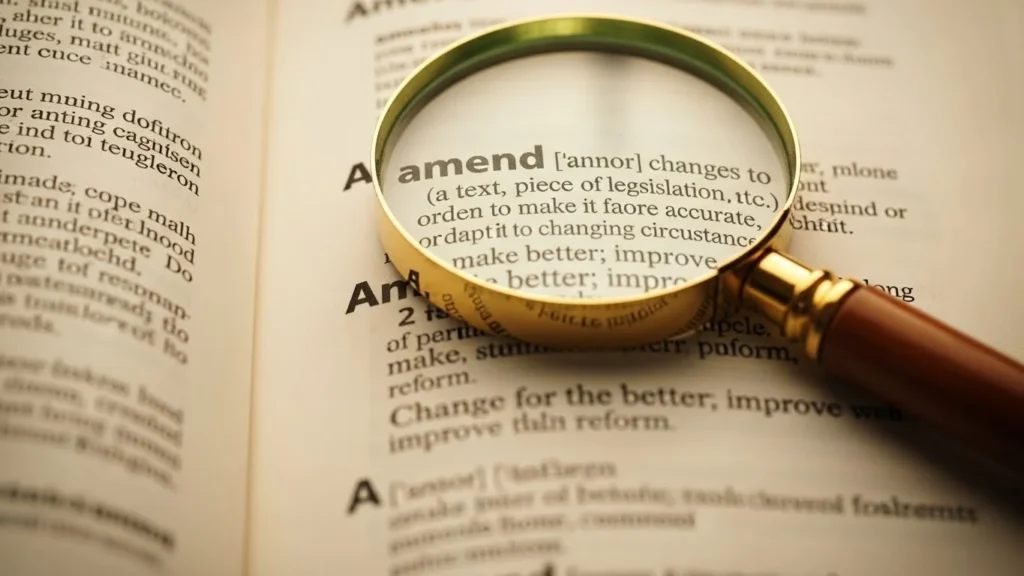

What Does “Amend” Meaning in Chat or Text?
Amend means to make changes, improvements, or corrections to something.
In simple words:
When you amend something, you fix it, improve it, or adjust it.
Different Contexts of Amend
Texting/Chat: Correcting a message, statement, or mistake.
Example: “Oops, I need to amend my last text.”Professional/Business: Updating a contract, report, or email.
Example: “Please amend the draft before sending it to the client.”Legal: Changing or revising laws, rules, or official documents.
Example: “The government decided to amend the tax regulations.”
Origin:
The word comes from the Latin emendare, meaning “to free from fault” or “to correct.”
How People Use “Amend” in Real Conversations
Amend is commonly used in texting, social media, and professional communication:
Texting with friends:
“I need to amend my message—I forgot to include the details.”
Meaning: Correcting or updating a previous text.Emails and workplace chats:
“Kindly amend the report with the latest figures.”
Meaning: Make corrections or improvements before submission.Legal discussions:
“The city council plans to amend the zoning laws.”
Meaning: Change or revise official rules or laws.
When it’s appropriate:
Correcting mistakes
Updating or improving something
Discussing legal or official documents
When it’s awkward:
Using amend casually when simple words like “fix” or “change” are better
Using it in jokes or informal chats where clarity matters
Real-Life Examples of “Amend” in Text Messages
Example 1:
Friend 1: “I sent the wrong location.”
Friend 2: “No worries, just amend it in the message.”
Explanation: Correct the mistake in the previous text.Example 2:
“Can you amend the Google Doc with my new edits?”
Explanation: Make changes or updates in a shared document.Example 3:
“The rules need to be amended to include remote workers.”
Explanation: Official rules are being updated or revised.Example 4:
“I have to amend my last comment—it was unclear.”
Explanation: Clarifying or correcting a previous statement.Example 5:
“They amended the policy after employee feedback.”
Explanation: Changes were made to improve the policy.
Common Mistakes & Misunderstandings
Confusing amend with mend: Mend usually refers to repairing physical objects, while amend is for documents, statements, or policies.
Using amend casually in informal chat: While not wrong, simpler words like “fix” or “change” may feel more natural.
Assuming amend means apologize: Amend can mean to correct a mistake, but not always to say sorry.
Mixing legal and casual meanings: In legal contexts, amend often has official implications.
Related Slangs & Abbreviations
Words and phrases related to amend include:
Edit: Make changes to text or content
Revise: Update or improve a document
Update: Modernize or bring something current
Correct: Fix a mistake
Patch: Informal term for fixing issues in software or documents
Internal linking opportunities: Articles on revise meaning, edit meaning, or update meaning provide readers extra context.