

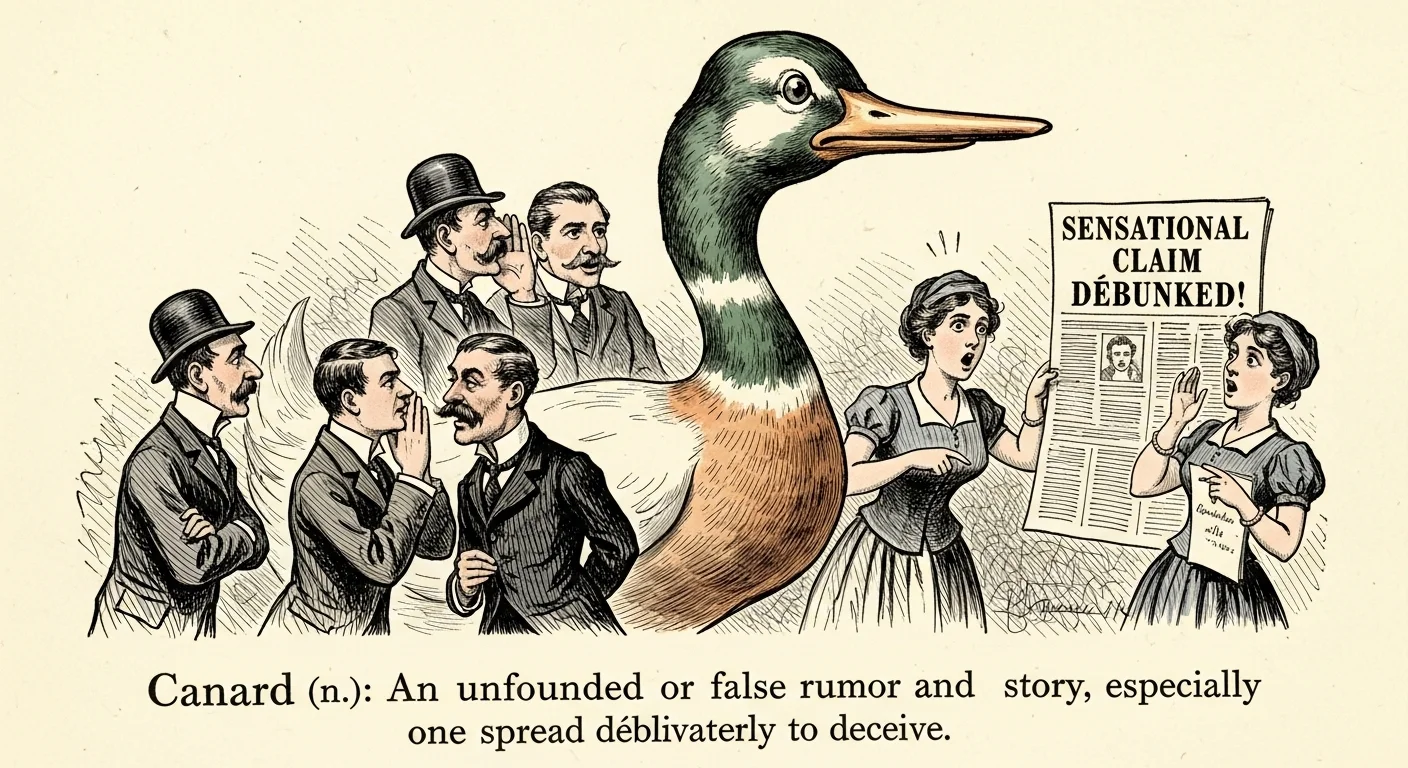
🇫🇷 Canard Meaning French
- Literal meaning: “duck” in French.
- Used to describe the bird species.
- Common in French cuisine (e.g., “Canard à l’orange”).
- Appears in French idioms and sayings.
- Can also mean a false story or rumor in French slang.
- Used in literature and everyday language.
- Symbolizes agility in water and air.
- Often used in hunting contexts.
- May appear in children’s books and songs.
- Derived from Old French “canart.”
📖 Canard Meaning in English
- Originally borrowed from French, meaning “duck.”
- Also used metaphorically to mean “false story” or “hoax.”
- Refers to exaggerated or misleading news.
- Common in journalism and literature.
- Example: “The article was a canard, not factual.”
- Sometimes used in debates or discussions.
- Can describe deliberate misinformation.
- Also used humorously in informal writing.
- Less common than the French literal meaning.
- Often appears in idiomatic expressions.
🔄 Canard Synonym
- Rumor – unverified story.
- Hoax – deliberate deception.
- Fabrication – false creation.
- False report – misleading information.
- Myth – widely believed but false.
- Lie – intentional untruth.
- Misrepresentation – giving false impression.
- Exaggeration – overstated fact.
- Tall tale – implausible story.
- Gossip – casual, unverified information.
✈️ Canard Meaning in Aircraft
- Small wing or horizontal stabilizer in front of main wings.
- Provides lift and stability.
- Common in fighter jets and experimental aircraft.
- Improves control and maneuverability.
- Can help reduce stall risk.
- Named after duck’s wing configuration.
- Important in aerodynamics design.
- Seen in aviation engineering textbooks.
- Often paired with delta wings.
- Example: “The fighter jet features a forward canard.”
📝 Canard in a Sentence
- “The politician’s speech was dismissed as a canard.”
- “He spread a canard about the company’s finances.”
- “The novel included a canard to mislead readers.”
- “A forward canard improves the aircraft’s lift.”
- “The journalist uncovered a canard in the media report.”
- “It’s easy to mistake a canard for truth if not fact-checked.”
- “The canard about the treasure excited many adventurers.”
- “Engineers added a canard to enhance aerodynamics.”
- “She told a canard to make the story more interesting.”
- “Canard designs are popular in modern fighter jets.”
🇦🇪 Canard Meaning in Arabic
- بط (Baṭ) – literal meaning: duck.
- إشاعة (Ishaa’a) – metaphorical: rumor or false story.
- خبر زائف (Khabar Zaa’if) – false news.
- شائعة (Shaya’a) – gossip or unverified information.
- خدعة (Khad’ah) – hoax or trick.
- قصّة مختلقة (Qissa Mukhtalqa) – fabricated story.
- أسطورة (Ustura) – myth or legend.
- تصريح كاذب (Tasreeh Kazib) – misleading statement.
- قول مبالغ فيه (Qawl Mubalag fih) – exaggeration.
- خبر مضلل (Khabar Mudallil) – misleading report.
🚗 Canard Meaning Car
- Small aerodynamic fin or spoiler in front of a vehicle.
- Helps improve airflow and stability.
- Often used in sports cars and racing vehicles.
- Designed to reduce lift and increase downforce.
- Inspired by aircraft canard design.
- Sometimes decorative in custom car builds.
- Appears in automotive engineering and design guides.
- Can affect fuel efficiency and handling.
- Example: “The race car had front canards for better cornering.”
- Popular in motorsport modifications.
🇨🇳 Canard Meaning in Chinese
- 鸭 (yā) – literal meaning: duck.
- 谣言 (yáoyán) – false story or rumor.
- 假消息 (jiǎ xiāoxi) – hoax or misinformation.
- 鸭子 (yāzi) – common word for duck in everyday speech.
- 不真实的报道 – untrue report.
- 虚构故事 – fabricated tale.
- 用于比喻 – used metaphorically.
- 鸭子相关食品 – food related to duck.
- 飞机小翼 – aircraft canard wing.
- 汽车小翼 – car front canard.
What Does Canard Meaning?
A canard is a false story, rumor, or misleading report.
In simple words:
Canard means a piece of information that is untrue but presented as fact.
Example:
“The politician dismissed the story as a canard.”
Meaning: The politician said the story was false or misleading.
Origin of Canard
The word canard comes from French, where it literally means “duck.”
In 16th-century French slang, it came to mean a false or exaggerated story, possibly linked to the phrase “vendre un canard à moitié” (selling half a duck, i.e., deceiving someone).
Today, canard is used in English to describe rumors or fabricated information.
How Canard Is Used in Language
Media and journalism: “The report was dismissed as a canard.”
Everyday conversation: “Don’t believe that story; it’s just a canard.”
Literature: Authors use canard to describe misinformation or gossip in stories
It’s typically used in formal or semi-formal contexts, rather than casual slang.
Real-Life Examples of Canard
“The claim that the product cures all diseases is a canard.”
Meaning: The claim is false and misleading.“He spread a canard about his rival to gain an advantage.”
Meaning: He shared a false story to manipulate opinion.“The newspaper article was criticized for publishing a canard.”
Meaning: The article contained false information.

Common Misunderstandings
People sometimes misunderstand canard because:
They think it means something humorous or harmless (it usually implies falsehood)
They confuse it with gossip (canard is more formal and often deceptive)
They assume it refers to literal ducks (the literal French meaning is “duck,” but in English it refers to false stories)
Clarification:
Canard is a false report, rumor, or misleading story, not a literal duck.
Related Words and Concepts
Words often linked to canard include:
Rumor – Unverified information
Hoax – A deliberate deception
Fabrication – Something made up
Misinformation – Incorrect or misleading information
Falsehood – The state of being untrue
These help understand different ways false information can be described.