



The word complaisant meaning describes a person who is polite, willing to please others, and eager to be agreeable. It comes from the idea of showing kindness and willingness to accommodate others’ wishes, often by being cooperative and easy-going. Understanding the meaning of complaisant is important because it is used in formal writing, literature, and descriptions of personality traits. A complaisant person is often seen as pleasant, respectful, and considerate in social situations. However, depending on context, it can sometimes imply being too eager to please or lacking strong personal resistance. The word is often confused with “compliant,” but complaisant focuses more on social politeness and friendliness rather than obedience. This article explores the definition, uses, and examples of “complaisant,” helping you clearly understand how the word is used to describe behavior and attitude in different situations.

⚖️ Complaisant vs Complacent
- Complaisant means willing to please others; obliging and agreeable
- Complacent means self-satisfied, often ignoring problems or risks
- Complaisant = people-pleasing attitude
- Complacent = careless confidence or smugness
- Complaisant is about others’ feelings
- Complacent is about your own satisfaction
- Example: a complaisant friend helps everyone
- Example: a complacent manager ignores issues
- They sound similar but meanings are very different
- Complaisant = socially agreeable; Complacent = dangerously relaxed
🔁 Complaisant synonym
- Obliging
- Agreeable
- Accommodating
- Cooperative
- Submissive
- Yielding
- Helpful
- Considerate
- Pleasant
- Willing
🔊 Complaisant pronunciation
- Pronounced: kom-PLAY-zuhnt
- Phonetic: /kəmˈpleɪ.zənt/
- Stress on second syllable: PLAY
- Sounds similar to “complacent” but different meaning
- Three syllables
- Formal English word
- Often used in literature or psychology contexts
- Easy confusion in spelling and pronunciation
- Not commonly used in casual speech
- Clear “z” sound in middle
✍️ Complaisant in a sentence
- She was complaisant and always agreed with her friends
- The waiter remained complaisant despite rude customers
- His complaisant attitude made him popular at work
- A complaisant employee avoids conflict
- She is too complaisant to refuse requests
- The complaisant assistant helped everyone
- He had a complaisant nature in social situations
- Complaisant behavior is often mistaken for weakness
- They appreciated his complaisant personality
- The complaisant host made everyone comfortable
🔁 Complaisant antonyms
- Stubborn
- Uncooperative
- Assertive
- Resistant
- Defiant
- Inflexible
- Independent
- Strong-willed
- Rebellious
- Self-assertive
⚖️ Complicit meaning
- Complicit means being involved in wrongdoing or a crime with others
- Suggests silent agreement or participation
- Example: being complicit in fraud
- Can involve direct or indirect involvement
- Often used in legal and moral contexts
- Implies shared responsibility
- Can be active or passive participation
- Negative ethical meaning
- Common in news and law discussions
- Example: “She was complicit in the cover-up”
🤝 Acquiescent meaning
- Acquiescent means accepting something without protest
- Often involves quiet agreement
- May suggest lack of resistance
- Can imply passive acceptance
- Example: acquiescent employee accepting rules
- Neutral or slightly negative tone
- Used in psychology and behavior studies
- Related to compliance or submission
- Not actively opposing decisions
- Common in formal writing
📜 Complaisant etymology
- Comes from French “complaisant”
- From Latin root complacere
- “com-” = together, fully
- “placere” = to please
- Original meaning: desire to please others
- Entered English in the 17th century
- Historically meant courteous or agreeable behavior
- Over time became more formal and less common
- Still used in literary or academic English
- Shares root with “complacent” but meaning diverged

Table of Contents
ToggleWhat Does Complaisant Mean?
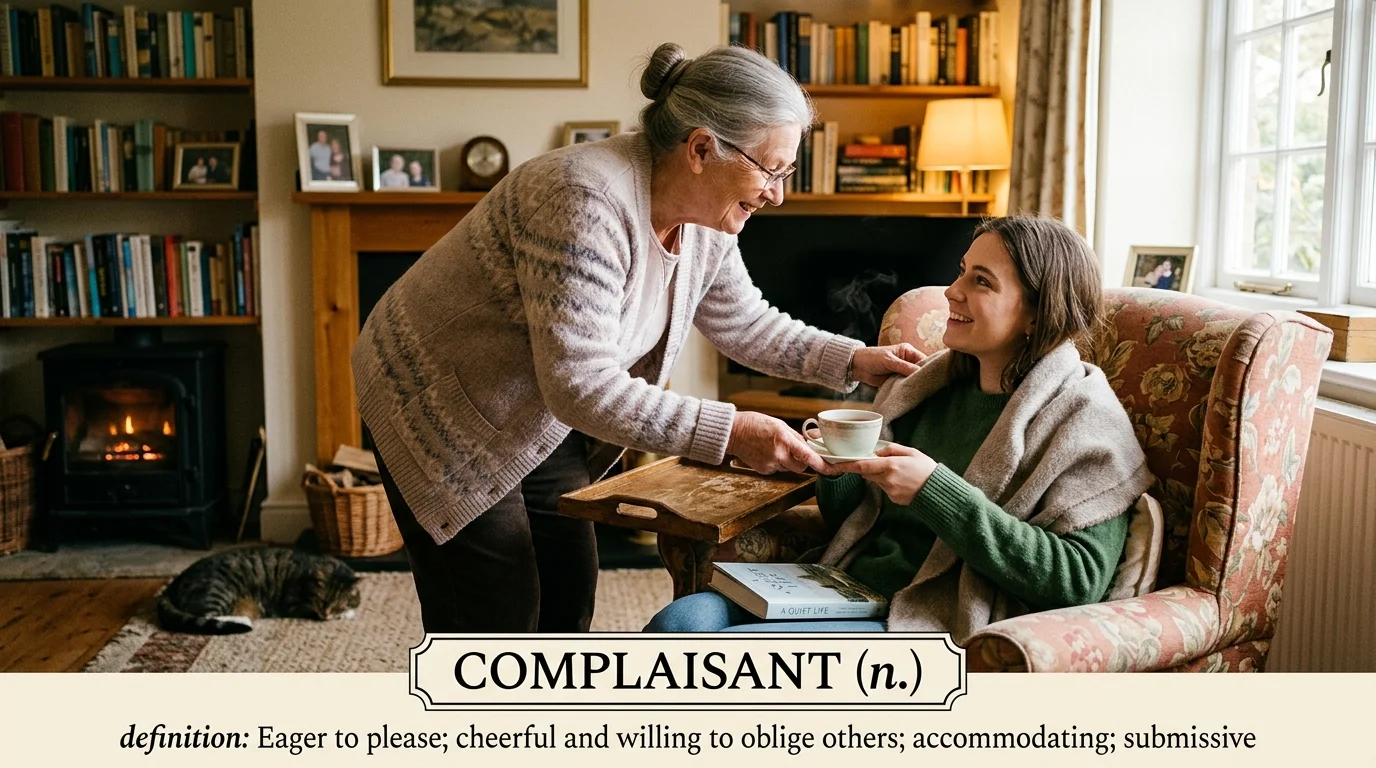
Complaisant is an adjective used to describe someone who is willing to please others, agreeable, or accommodating.
In simple words:
Complaisant means being friendly, cooperative, and eager to help or satisfy others.
Example:
“She was so complaisant that she agreed to every suggestion at the meeting.”
Meaning: She was agreeable and accommodating, willing to go along with others’ ideas.
Complaisant in Behavior and Personality
A complaisant person often:
Avoids conflict
Tries to please others
Is cooperative and flexible
Shows politeness and willingness
Note: Being complaisant is generally positive, but excessive complaisance can sometimes lead to being taken advantage of.
Complaisant Meaning vs Agreeable
While complaisant and agreeable are similar:
Agreeable: Generally friendly and pleasant
Complaisant: Friendly with an emphasis on being accommodating and eager to please
Example:
Agreeable: “He is agreeable and easy to talk to.”
Complaisant: “He is complaisant and will adapt to others’ wishes.”
Real-Life Examples of Complaisant
“The complaisant host welcomed every guest’s request.”
Meaning: The host was very accommodating and eager to please.“She was complaisant in helping her colleagues finish the project.”
Meaning: She cooperated and supported her teammates willingly.“His complaisant nature made him popular among friends.”
Meaning: People liked him because he was easy-going and accommodating.
Common Misunderstandings
People often misunderstand complaisant because:
They think it means passive or weak (it emphasizes willingness, not weakness)
They confuse it with simply polite or friendly behavior
They assume it always has a negative connotation
Clarification:
Complaisant describes willingness to please and cooperate, which can be positive or neutral depending on context.
Related Words
Words often linked to complaisant include:
Accommodating
Agreeable
Obliging
Cooperative
Compliant
These words are helpful when describing people who are cooperative and easy to get along with.
FAQs
What does complaisant mean in simple words?
It means someone who is willing to please, accommodating, or cooperative.
Is complaisant a positive trait?
Yes, generally it’s positive, though excessive complaisance can sometimes be seen as weakness.
Can complaisant describe behavior at work?
Yes, it’s often used to describe cooperative, accommodating, or helpful colleagues.
Is complaisant the same as polite?
Not exactly. Polite is about manners; complaisant is about being eager to please and cooperate.
Can complaisant describe a personality?
Yes, it describes a person’s overall tendency to be agreeable and accommodating.
Conclusion
The complaisant meaning is simple: it describes someone cooperative, accommodating, and eager to please others. Whether in social situations, at work, or in personal relationships, being complaisant can help build harmony and positive interactions.