

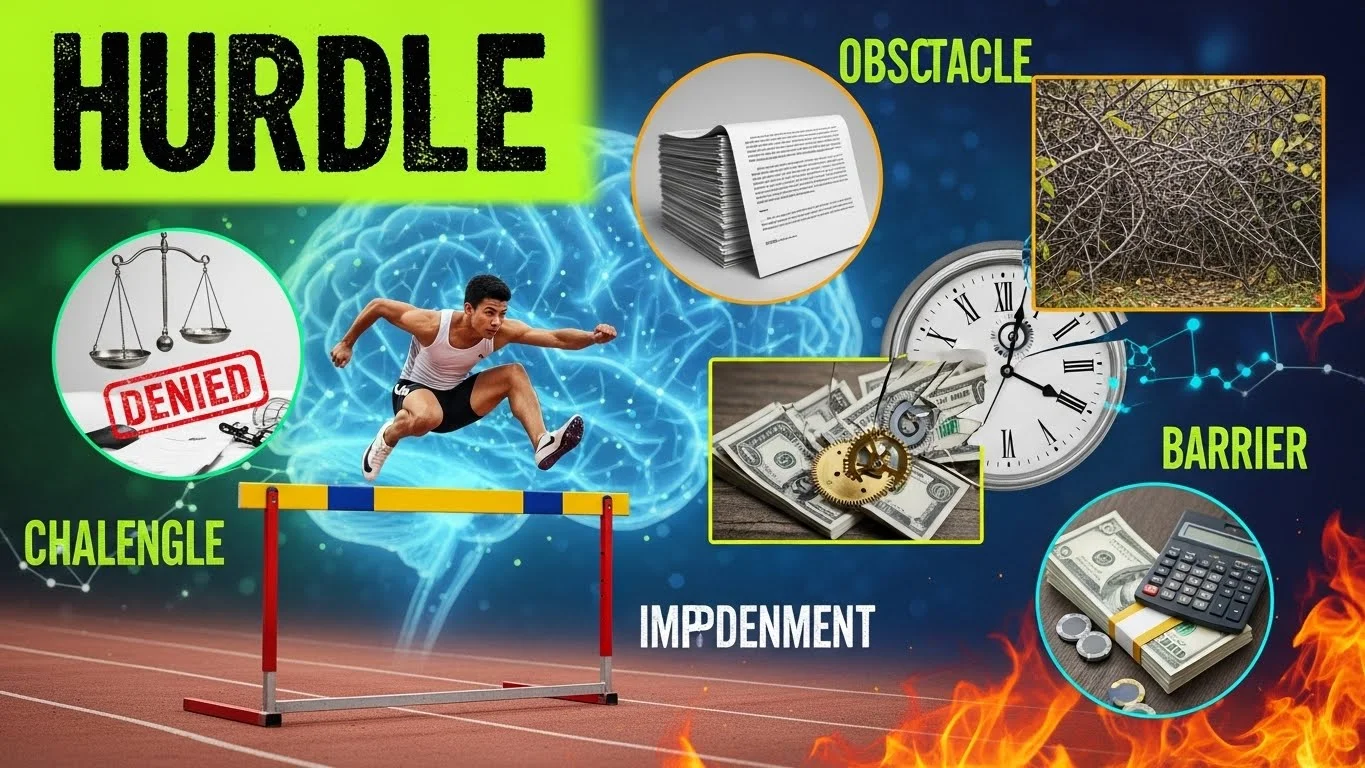
What Does “Hurdle” Meaning?
Hurdle can be a noun or a verb, with literal and figurative meanings:
As a Noun
Sports Context:
A barrier used in races, which runners must jump over.
Example: “She cleared every hurdle in the 100m race.”
Figurative Meaning:
An obstacle, difficulty, or challenge in life or work.
Example: “Finding a job after graduation was a big hurdle.”
As a Verb
To overcome or jump over obstacles:
Example: “He hurdled the problems and succeeded in his career.”
Origin of the Word
Comes from Middle English “hurdil”, a diminutive of “hurd,” meaning a fence or barrier.
Historically used in agriculture before being adapted into athletics.
How People Use “Hurdle” in Real Life
Sports
“The athlete trained for months to perfect her hurdling technique.”
Refers to literal barriers in track and field races.
Everyday Life
“Paying off student loans is a huge hurdle for many young adults.”
Refers to challenges or difficulties people face.
Motivational or Professional Use
“Overcoming communication hurdles can improve teamwork.”
Refers to obstacles in the workplace or personal growth.
Real-Life Examples
Example 1 (Sports):
Sentence: “He fell at the last hurdle during the 110m race.”
Explanation: Literal barrier in an athletic race.
Example 2 (Life Challenges):
Sentence: “Getting a visa was the first hurdle in our travel plans.”
Explanation: Figurative meaning—an obstacle to overcome.
Example 3 (Verb Use):
Sentence: “She hurdled every challenge and completed the project on time.”
Explanation: Means she successfully overcame difficulties.
Common Mistakes & Misunderstandings
Confusing literal and figurative uses: Make sure context is clear.
Overusing in casual conversation: Can sound formal or motivational; use sparingly in everyday chat.
Wrong verb form: “He hurdled over the hurdle” is correct; “he hurdled the hurdle over” is not.
Tip: Identify whether you’re referring to sports, life challenges, or metaphorical obstacles to use the word correctly.
Related Words & Phrases
Obstacle – something blocking progress
Barrier – literal or figurative impediment
Challenge – difficulty to overcome
Hurdling – the act of jumping over barriers in sports
Roadblock – figurative term for an obstacle
Internal Linking Opportunity: Could link to articles like obstacle meaning, barrier meaning, or challenge meaning.