

😎 IDS Meaning Slang
- In slang, IDS is not very common
- Sometimes used as short form of “I don’t see” in casual texting
- Example: “IDS what you mean” (meaning “I don’t see what you mean”)
- Not a standard or widely accepted slang
- Meaning depends on context
- Mostly seen in informal chat
- Can be confusing without explanation
- Not used in professional communication
- Rare compared to tech meaning
- Usually refers to cybersecurity instead
🔐 IDS Meaning in Security
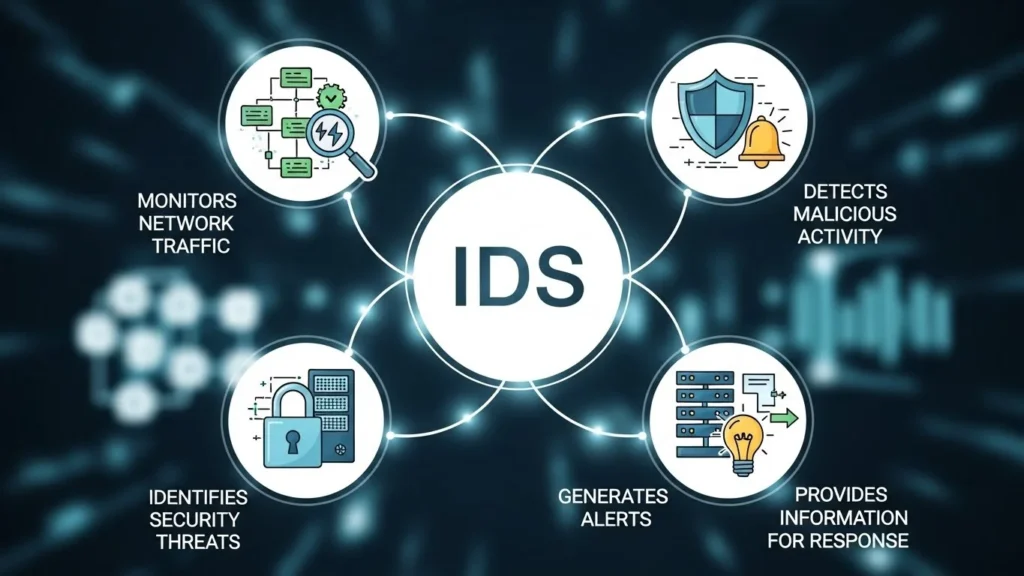
- In security, IDS means Intrusion Detection System
- It is a system that monitors networks for suspicious activity
- Detects unauthorized access or attacks
- Alerts administrators about threats
- Does NOT block attacks (only detects)
- Used in cybersecurity protection
- Helps prevent hacking and data breaches
- Works in real-time monitoring
- Important for IT security systems
- A key cybersecurity tool
🧠 Types of IDS
- NIDS (Network Intrusion Detection System)
- Monitors network traffic
- HIDS (Host Intrusion Detection System)
- Monitors a single device or computer
- Signature-based IDS
- Detects known attack patterns
- Anomaly-based IDS
- Detects unusual behavior
- Hybrid IDS
- Combination of multiple types
- Used depending on security needs
- Helps improve protection
- Common in cybersecurity systems
- Each type has specific use cases
- Important classification in IT security
🛡️ Intrusion Detection System Examples
- Snort
- Suricata
- OSSEC
- Bro (Zeek)
- Security Onion
- Used for detecting cyber threats
- Monitor traffic and system logs
- Alert administrators of attacks
- Widely used in cybersecurity industry
- Help protect organizations
⚙️ How IDS Works
- Monitors network or system activity
- Collects data packets and logs
- Compares activity with known attack patterns
- Detects unusual or suspicious behavior
- Sends alerts to security teams
- Does not stop attacks automatically
- Works in real-time or batch mode
- Uses rules or machine learning
- Helps identify security threats early
- Essential for cyber defense
🧰 IDS Tools
- Snort
- Suricata
- OSSEC
- Zeek
- Security Onion
- Used for monitoring and alerts
- Detect malware and attacks
- Widely used in IT security
- Free and paid tools available
- Essential for network protection
🚨 Intrusion Prevention System (IPS)
- IPS (Intrusion Prevention System) goes one step further than IDS
- Detects and automatically blocks threats
- Works in real-time
- Prevents attacks before damage occurs
- Often combined with IDS
- Used in firewalls and security systems
- Protects networks from intrusion
- More active than IDS
- Important in cybersecurity defense
- Helps stop cyberattacks
🏥 What is IDS Disease
- IDS disease is not a medical term
- People may confuse it with immunodeficiency disorders
- Example: immune system weakness conditions
- Proper term is immunodeficiency syndrome (like AIDS)
- Not related to Intrusion Detection System
- Context confusion in search queries
- Always check medical accuracy
- IDS in medicine is not standard
- Likely misunderstanding of abbreviation
- Important to clarify context
What Does IDS Meaning?
IDS stands for Intrusion Detection System in technology and security contexts.
In simple words:
An IDS is a system or software that monitors a network or computer for suspicious activity or attacks.
Example:
“Our company installed an IDS to detect unauthorized access attempts.”
Meaning: The system helps identify hackers or suspicious activities on the network.
IDS in Technology and Security
-
Purpose: To detect threats, intrusions, or unusual activity in computer systems or networks
-
Types of IDS:
-
Network-based IDS (NIDS): Monitors traffic across a network
-
Host-based IDS (HIDS): Monitors activity on individual computers
-
-
Function: Alerts administrators about suspicious events and potential security breaches
IDS is an essential tool for cybersecurity, helping prevent attacks and protect data.
IDS in Other Contexts
Apart from technology, IDS can have different meanings depending on the context:
-
Identification (IDS): Referring to ID cards or identification systems
Example: “Make sure to carry your IDS for access.” -
International Decision Support (IDS): Used in business or research settings
-
Industrial Design Society (IDS): Professional association in design fields
Context determines which IDS meaning is relevant.
Real-Life Examples of IDS
-
“The network IDS alerted us to multiple failed login attempts.”
Meaning: The security system detected suspicious activity. -
“Please show your IDS at the building entrance.”
Meaning: Show your identification badge or system. -
“Our research team used IDS software to analyze cybersecurity threats.”
Meaning: The team monitored networks using intrusion detection tools.
Common Misunderstandings
People sometimes misunderstand IDS because:
-
They assume it only refers to ID cards (it often relates to security systems in tech)
-
They confuse it with antivirus software (IDS detects, antivirus removes threats)
-
They think all IDS automatically block attacks (some only alert administrators)
Clarification:
IDS is mainly about monitoring and detecting unusual or harmful activity, not always preventing it.
Related Words and Concepts
-
IPS (Intrusion Prevention System) – Monitors and blocks threats automatically
-
Firewall – Protects networks by controlling incoming/outgoing traffic
-
Antivirus – Detects and removes malware
-
Cybersecurity – The practice of protecting computers and networks
-
Authentication – Verifying identity in digital systems
These terms help understand how IDS fits into technology and security.