

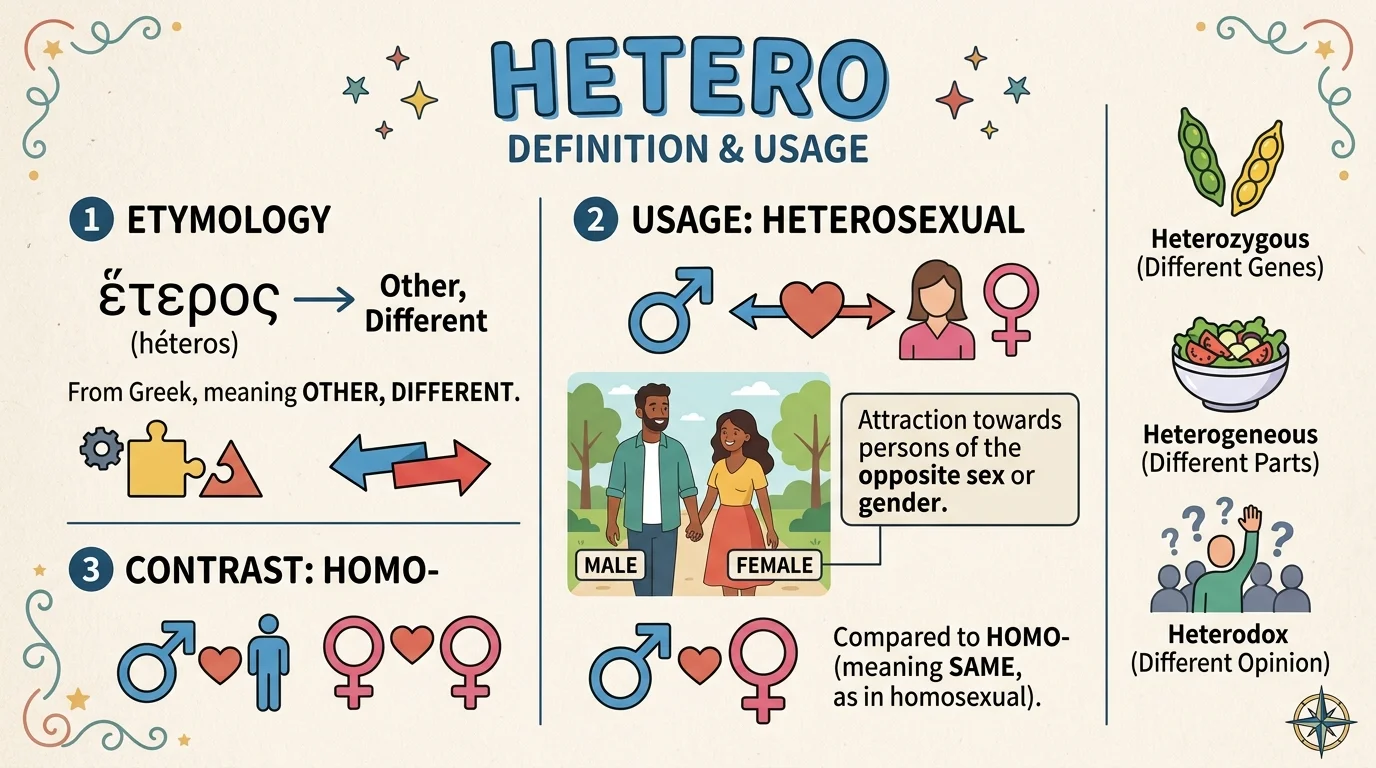
🧬 Hetero meaning in biology
- In biology, hetero means “different” or “other”
- Comes from a Greek root used in scientific terms
- Seen in words like heterozygous and heterotroph
- Describes organisms or traits that are unlike or mixed
- Opposite of “homo,” meaning same
- Used in genetics and ecology
- Can describe different alleles in genes
- Important in biological classification
- Common scientific prefix in textbooks
- Helps explain diversity and variation
❤️ Does hetero mean straight
- Yes, “hetero” is short for heterosexual
- Means attraction to the opposite gender
- “Straight” is the informal everyday word
- Common in dating and identity discussions
- Used in social and medical contexts
- Opposite of homosexual in orientation terms
- Often used in profiles or conversations
- Neutral descriptive term
- Widely recognized internationally
- Can be shortened casually to “hetero”
💕 Hetero meaning in dating
- In dating, hetero means being attracted to the opposite gender
- Short form of heterosexual
- Often used in dating apps and profiles
- Helps describe romantic preference
- Common identity label in relationships
- Can appear in social media bios
- Used casually and formally
- Example: hetero male or hetero female
- Helps people identify compatibility
- One of the most common orientation terms
⚗️ Hetero meaning in chemistry
- In chemistry, hetero means “different” or involving another element
- Seen in terms like heterocyclic compounds
- Refers to structures containing different atoms
- Common in organic chemistry vocabulary
- Opposite of “homo” meaning same type
- Used for mixed molecular structures
- Important in chemical classification
- Can involve atoms like oxygen, nitrogen, or sulfur
- Helps describe compound composition
- Frequently used in scientific research
📘 Hetero meaning in English
- Hetero means “different” or “other”
- Comes from ancient Greek language
- Used as a prefix in science and social terms
- Often short for heterosexual in everyday speech
- Appears in biology, chemistry, and sociology
- Opposite of “homo” meaning same
- Describes difference or variation
- Common in academic and casual language
- Meaning changes slightly by context
- A widely used Greek-root prefix
🌱 Hetero meaning in heterotroph
- In “heterotroph,” hetero means “other”
- A heterotroph gets food from other organisms
- Opposite of autotroph, which makes its own food
- Humans and animals are heterotrophs
- Important concept in biology and ecology
- Describes organisms dependent on external nutrition
- Common term in science classes
- Shows relationship between organisms and energy
- Derived from Greek roots
- Key word in food chain studies
🏛️ Hetero meaning Greek
- “Hetero” comes from Greek word heteros
- Means “different,” “other,” or “another”
- Used in many English scientific words
- Opposite Greek root is “homo” meaning same
- Common in biology, chemistry, and sociology
- Ancient Greek origin still used today
- Helps form technical vocabulary
- Represents diversity or difference
- Important root in academic language
- Found in many modern English terms
🇫🇷 Hetero meaning in French
- In French, “hétéro” is short for hétérosexuel
- Means heterosexual or straight
- Common in everyday French conversation
- Used in dating and identity contexts
- Pronounced roughly as “ay-tay-ro”
- Also appears in scientific terms
- Comes from the same Greek root meaning different
- Used casually in spoken French
- Neutral descriptive term
- Widely understood in modern French language

What Does Hetero Mean?
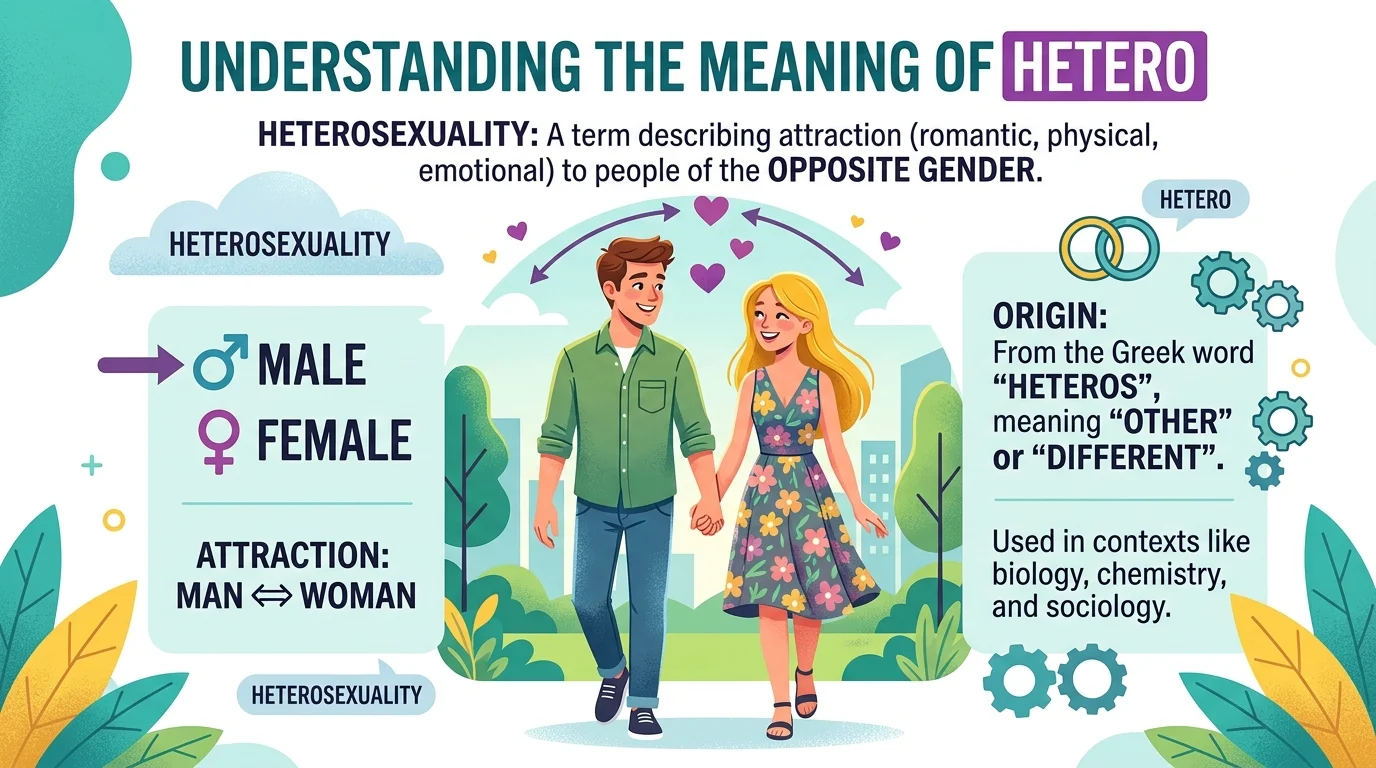
Hetero is short for heterosexual. It describes a person who is attracted to people of the opposite gender.
The term is often used in casual speech, writing, and online spaces as a shorter, informal version.
Hetero Meaning in Simple Terms
In simple language, hetero means:
Being attracted to the opposite gender
A shorter way to say heterosexual
A descriptive term, not an insult
Origin of the Word Hetero
The word hetero comes from the Greek word “heteros,” which means different or other.
Over time, it became part of modern language to describe different types of attraction.
How Hetero Is Used in Daily Life
People use hetero to:
Describe themselves
Talk about relationships
Label preferences in profiles
Explain orientation in discussions
It is usually neutral and factual.
Hetero in Conversations
In casual conversations, hetero may appear as:
“He identifies as hetero.”
“She’s hetero and in a long-term relationship.”
It’s often used when clarity is needed, not in everyday small talk.
Hetero in Social Media and Online Profiles
Hetero is commonly seen in:
Dating apps
Social media bios
Forums and discussion boards
It helps people quickly understand personal preferences.
Hetero vs Straight
Hetero: Short, slightly more neutral or descriptive
Straight: More casual and commonly spoken
Both usually mean the same thing in modern usage.
Is Hetero a Formal Word?
Hetero is considered:
Neutral
Semi-formal
Informational
It’s acceptable in both casual and educational contexts.
Hetero in Writing
In writing, hetero is often used in:
Articles
Academic discussions
Explanatory content
It’s best to use it clearly and respectfully.
Common Situations Where Hetero Is Used
Personal descriptions
Educational content
Social discussions
Media and articles
Common Misunderstandings
Hetero is not slang-only
It is not negative by default
It does not describe personality traits
It simply describes a type of attraction.
Hetero as an Adjective
Hetero is mainly used as an adjective, not a noun.
Example:
“Hetero relationships are commonly discussed in media.”
Hetero in Modern English
In modern English, hetero is:
Widely understood
Common online
Used globally
Related Words and Terms
Heterosexual
Straight
Orientation
Relationship
These terms are often used together for clarity.
When Not to Use Hetero
Avoid using hetero:
As a joke or insult
Without context
In sensitive discussions without care
Respectful usage matters.
Why Understanding Hetero Matters
Knowing the hetero meaning helps you:
Understand conversations accurately
Communicate respectfully
Avoid confusion or misuse
Hetero in Education
In educational contexts, hetero is used to:
Explain relationship types
Teach social concepts
Clarify terminology
Tone and Sensitivity
Hetero is best used:
Neutrally
Respectfully
Without assumptions
Language works best when used thoughtfully.
Examples of Hetero in Sentences
He identifies as hetero.
The article discusses hetero relationships.
She mentioned she is hetero during the conversation.