
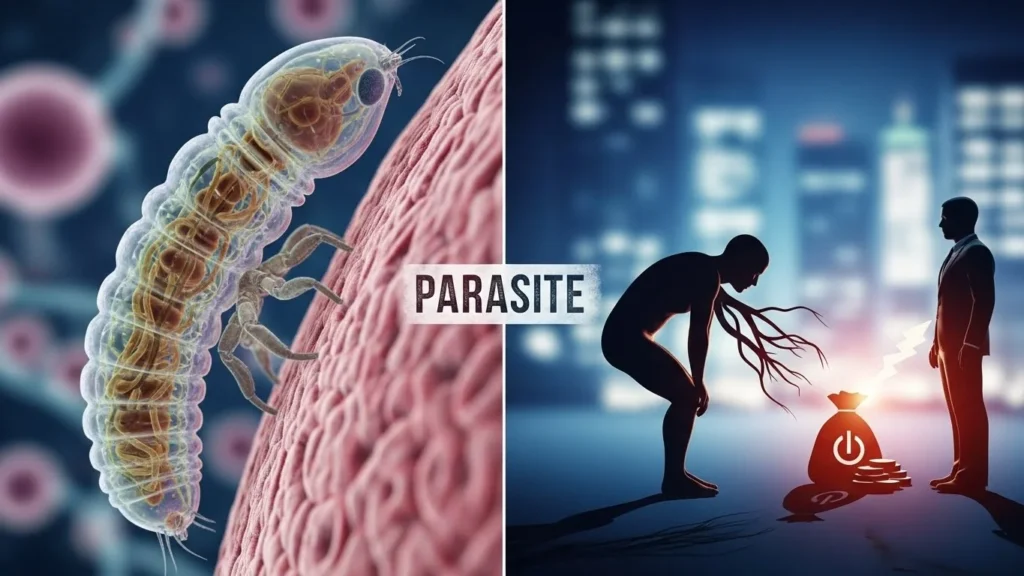
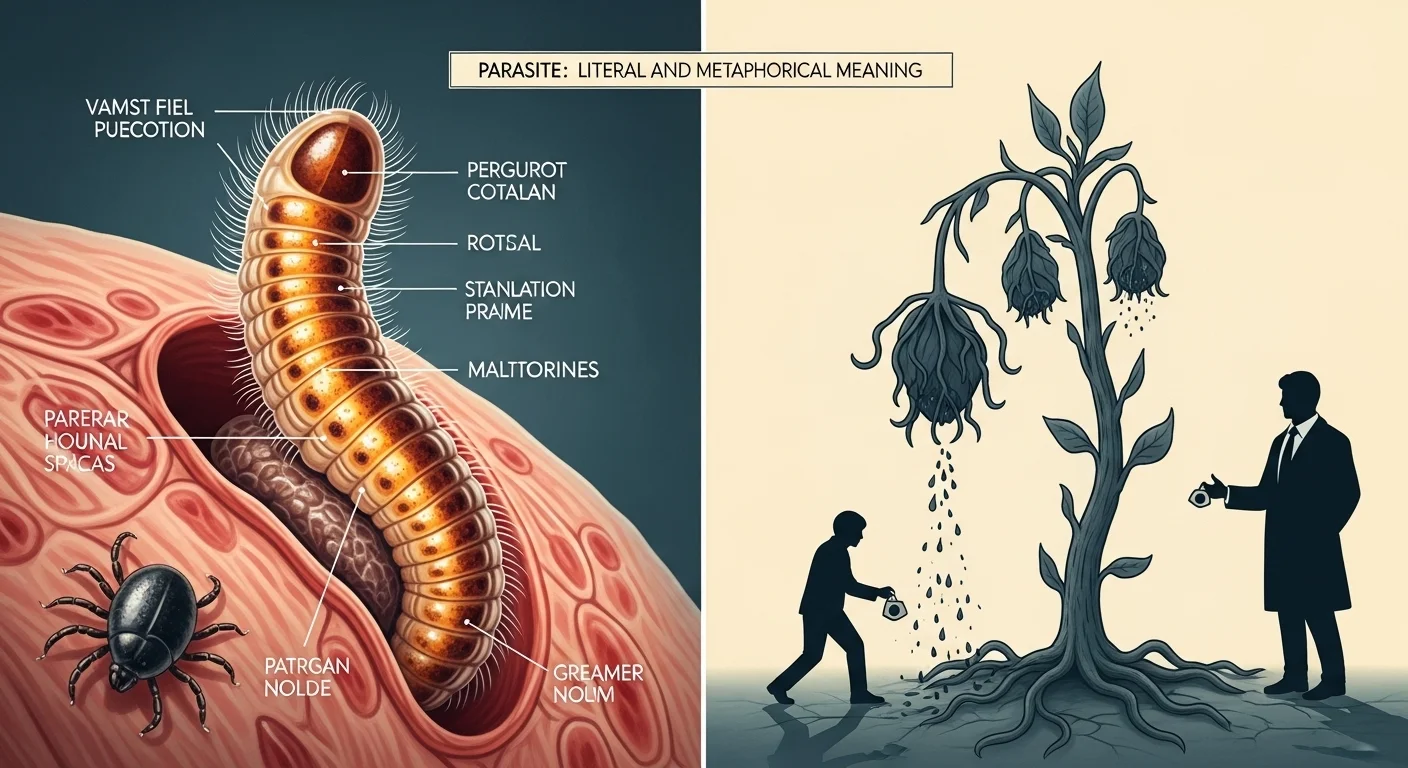
😎 Parasite Meaning Slang
- In slang, “parasite” means a person who takes advantage of others without giving anything back
- Often used as an insult
- Refers to someone who depends on others financially or emotionally
- Example: “He’s acting like a parasite, always taking but never helping.”
- Can describe lazy or selfish behavior
- Strong negative tone in informal speech
- Used in arguments or criticism
- Not a polite word
- Suggests exploitation
- Common in online discussions
🧬 Parasite Meaning in Biology
- A parasite is a living organism that lives on or inside another organism (host)
- It depends on the host for food and survival
- The host is usually harmed
- Examples: tapeworm, lice, malaria parasite
- Can live in animals, humans, or plants
- Studied in biology and microbiology
- Part of ecological relationships
- Parasites benefit while host is harmed
- Very common in nature
- Important concept in science
🧍 Parasite Meaning in Humans
- In humans, a parasite is an organism that lives in or on the human body
- It feeds on human nutrients or blood
- Examples: intestinal worms, lice, ticks
- Can cause diseases and infections
- Spread through food, water, or contact
- Requires medical treatment
- Found in intestines, skin, or blood
- Can weaken the body
- Common in tropical regions
- Important topic in medical science
🇮🇷 Parasite Meaning in Farsi
- In Farsi, parasite means انگل (Angal)
- Refers to an organism that lives on another and harms it
- Used in biology and medicine
- Can also describe a dependent person (slang use)
- Common scientific term
- Used in health and education
- Similar meaning to English
- Indicates harmful dependence
- Used in both literal and figurative sense
- Negative meaning in slang usage
📘 Parasite Meaning in English
- A parasite is an organism that depends on another organism for survival and harms it
- Can also mean a person who depends on others unfairly
- Example: “The parasite lives off the host.”
- Used in biology and everyday language
- Often negative when used for people
- Represents dependency and exploitation
- Common scientific term
- Used in medical and ecological studies
- Can be literal or metaphorical
- Widely used English word
📝 Parasite Meaning Example
- “The tick is a parasite on animals.”
- “He is acting like a parasite, living off others.”
- “Malaria is caused by a parasite.”
- “The plant was infected by parasites.”
- “Some insects are parasites of crops.”
- “The parasite weakens the host body.”
- “She called him a social parasite.”
- “Parasites can spread diseases.”
- “The fish was affected by parasites.”
- “Human parasites require medical treatment.”
🔄 Parasite Meaning Synonyms
- Leech
- Freeloader
- Dependent
- Exploiter
- Sponger
- Scrounger
- Bloodsucker
- Pest
- Invader
- Hitchhiker
🎬 Parasite Meaning Movie
- “Parasite” is a famous South Korean film Parasite
- Directed by Bong Joon-ho
- Won the Academy Award for Best Picture
- Story about class differences and inequality
- Focuses on rich and poor families
- Uses “parasite” as a metaphor
- Represents social exploitation
- Dark comedy and thriller genre
- Highly critically acclaimed worldwide
- A powerful social commentary film

What Does “Parasite” Mean?
A parasite is an organism or entity that lives on or inside another organism (the host) and benefits at the host’s expense.
The term can also be used figuratively to describe people or behaviors that rely unfairly on others.
Parasite Meaning in Biology
In biology, a parasite is a living organism that depends on a host for survival.
Key Characteristics
-
Lives on or inside a host
-
Takes nutrients or resources
-
Usually causes harm or discomfort to the host
Common Biological Parasites
-
Tapeworms – live in intestines
-
Lice – live on the scalp
-
Mosquitoes – feed on blood (temporary parasites)
-
Ticks – attach to skin and feed
Types of Parasites
Endoparasites
-
Live inside the host
-
Examples: tapeworms, roundworms
Ectoparasites
-
Live on the surface of the host
-
Examples: fleas, lice, ticks
Temporary Parasites
-
Only visit the host briefly
-
Example: mosquitoes
Parasite Meaning in Everyday Language
Outside of biology, parasite is often used figuratively.
Figurative Meaning
A parasite can describe a person who depends on others for support while giving little or nothing in return.
Example:
-
“He lives off others without contributing—people call him a parasite.”
This usage is informal and often insulting, so it should be used carefully.
Real-Life Examples
Example 1 (Biology):
-
Sentence: “Malaria is caused by a parasite transmitted by mosquitoes.”
-
Explanation: Refers to a biological organism causing disease.
Example 2 (Everyday Speech):
-
Sentence: “She felt he was acting like a parasite, relying on her financially.”
-
Explanation: Figurative use, implying unfair dependence.
Example 3 (Science Context):
-
Sentence: “Parasites evolve to survive by adapting to their hosts.”
-
Explanation: Neutral, scientific usage.
Common Mistakes & Misunderstandings
-
Assuming parasite always means a worm: Parasites include insects, microorganisms, and more.
-
Using the word casually about people: It can be offensive if used carelessly.
-
Confusing parasites with bacteria or viruses: Parasites are living organisms, unlike viruses.
Tip: Check the context—scientific or figurative—before using the word.
Related Words & Concepts
-
Host – organism that supports a parasite
-
Symbiosis – close relationship between organisms
-
Mutualism – both organisms benefit
-
Commensalism – one benefits, the other is unaffected
-
Infection – invasion by parasites or microbes
Internal Linking Opportunity: Could link to articles like host meaning, symbiosis explained, or infection meaning.