

What Does Quasi Mean?
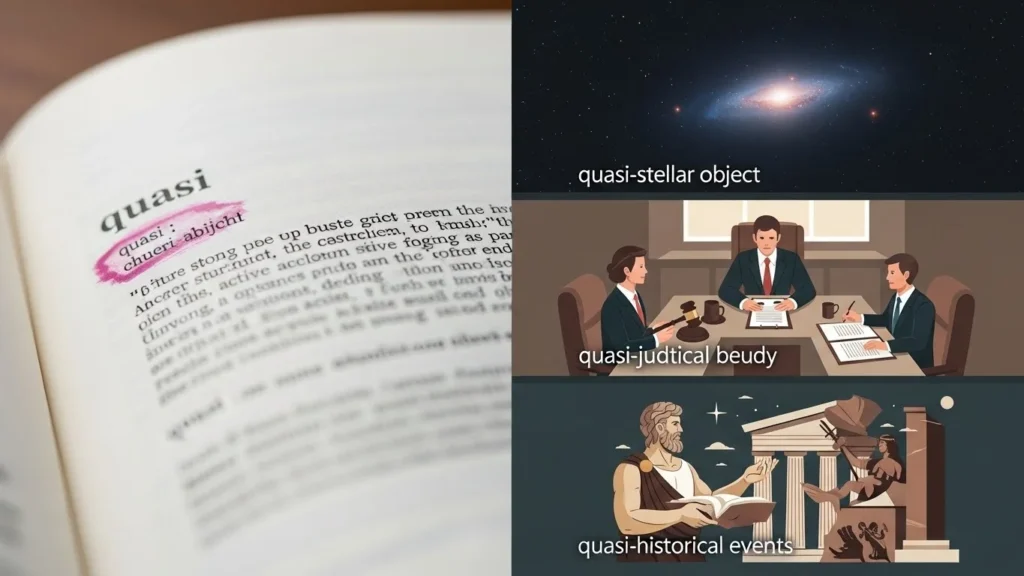
Quasi means “almost,” “partly,” or “seemingly.”
It is used to describe something that looks like a certain thing but is not fully or officially that thing.
Quasi Meaning in Simple Words
In simple words, quasi means:
-
Almost
-
Partly
-
Not fully real
-
Not officially recognized
It describes something that is halfway between two states.
Origin of the Word Quasi
The word quasi comes from Latin and originally meant “as if” or “like.”
Over time, English adopted it to describe things that resemble something without fully being it.
Quasi Meaning in Everyday Language
In daily life, people use quasi to describe situations that are not completely clear-cut.
For example, something may look official, act official, but not actually be official.
Quasi Meaning in Simple Sentences
-
“He has a quasi leadership role.”
-
“It was a quasi agreement, not a real contract.”
-
“The place felt like a quasi office.”
Each sentence shows something that is almost, but not fully, something else.
Quasi Meaning in Formal Writing
Quasi is often used in:
-
Academic writing
-
Legal documents
-
News articles
It adds precision when describing unclear or partial situations.
Quasi Meaning in Law
In legal contexts, quasi describes something that behaves like a legal concept but is not officially classified as one.
This helps courts explain gray areas clearly.
Quasi Meaning in Business and Workplaces
In business, quasi is used to describe:
-
Informal roles
-
Unofficial responsibilities
-
Temporary authority
For example, a “quasi manager” may act like a manager without the title.
Quasi Meaning in Government and Organizations
Organizations may have quasi structures that are:
-
Semi-independent
-
Partly official
-
Supported but not controlled
The word helps explain complex systems.
Quasi vs Almost
People often confuse quasi with almost.
-
Almost: Very close to something
-
Quasi: Similar in nature but not fully the same
Quasi focuses more on resemblance than closeness.
Quasi vs Pseudo
These words are related but different.
-
Quasi: Partly or seemingly real
-
Pseudo: Fake or pretending
Quasi does not always imply dishonesty.
Common Misunderstandings About Quasi
Some people think:
-
Quasi always means fake
-
It has a negative meaning
-
It’s only for academic use
None of these are always true.
Is Quasi a Negative Word?
Quasi is usually neutral.
Its tone depends on context, not the word itself.
Quasi Meaning for Non-Native English Speakers
For English learners, remember:
Quasi means “kind of, but not fully.”
This simple idea works in most cases.
Quasi in News and Media
Journalists use quasi to describe:
-
Unofficial groups
-
Informal power structures
-
Partial authority
It adds clarity without exaggeration.
Quasi Meaning in Modern Usage
Today, quasi is still common in:
-
Professional writing
-
Online discussions
-
Commentary and analysis
It remains relevant and useful.
When to Use Quasi
Use quasi when:
-
Something resembles another thing
-
The situation is unclear
-
The role or status is unofficial
It helps avoid oversimplification.
When Not to Use Quasi
Avoid using quasi in:
-
Very casual chat
-
Simple storytelling
-
Informal texting
It can sound too formal there.

Quasi Meaning Explained Simply
If you remember one thing:
Quasi means something is partly or almost something, but not fully.
That definition fits most contexts.
Why Quasi Is a Useful Word
Quasi helps express:
-
Uncertainty
-
Partial truth
-
Complex situations
That’s why it remains widely used.