

✅ Valid Meaning in English
- Valid means correct, acceptable, or legally/officially recognized
- Something that is valid is true, strong, or properly accepted
- Example: “This ticket is valid for one day.”
- Common in daily English
- Used in rules, logic, and documents
- Can mean “reasonable” or “well-supported”
- Opposite of invalid
- Widely used formal word
- Important in education and law
- Simple meaning: “allowed or correct”
🇸🇦 Valid Meaning in Arabic
- In Arabic, valid means صالح (ṣāliḥ) or ساري (sārī)
- Refers to something acceptable or legally correct
- Example: valid visa = تأشيرة صالحة
- Used in legal and formal contexts
- Means something is recognized or effective
- Common in documents and rules
- Indicates correctness or approval
- Widely used in official language
- Clear and formal translation
- Important administrative term
👤 “You Are Valid” Meaning
- “You are valid” means your feelings, thoughts, or experiences are real and important
- Used for emotional support
- Example: “It’s okay, you are valid.”
- Often used in mental health context
- Shows acceptance and understanding
- Helps people feel respected
- Common in supportive conversations
- Does not mean “correct” in logic sense
- Emotional affirmation phrase
- Very positive expression
🧒 Valid Meaning for Kids
- Valid means something is real, correct, or allowed
- Example: “A valid ticket means you can enter.”
- Means something is okay to use
- Helps explain rules simply
- Used in school and daily life
- Opposite of “not allowed”
- Easy word for children to understand
- Means something is accepted
- Simple and clear idea
- Common in instructions
✍️ Valid Meaning and Examples
- Valid = correct, acceptable, or legally true
- Example 1: “Your ID is valid.”
- Example 2: “That is a valid reason.”
- Example 3: “The passport is still valid.”
- Used in rules and logic
- Can mean strong argument
- Common in formal English
- Important in documentation
- Used in everyday situations
- Easy to understand meaning
🔬 Valid Meaning in Science
- In science, valid means logically correct or supported by evidence
- Example: valid experiment results
- Used in research and studies
- Means conclusions are accurate
- Important in scientific method
- Based on proper data
- Opposite of invalid or wrong
- Ensures reliability of findings
- Used in physics, biology, etc.
- Key concept in research
🔄 Valid Synonyms
- Correct
- Acceptable
- Legitimate
- Genuine
- Accurate
- Legal
- Reasonable
- True
- Reliable
- Official
💼 Valid Meaning in Business
- In business, valid means officially accepted or legally recognized
- Example: valid contract or valid invoice
- Important for transactions
- Ensures documents are correct
- Used in finance and administration
- Means legally enforceable
- Confirms authenticity
- Avoids disputes
- Common in corporate work
- A formal business term

What Does “Valid” Mean?
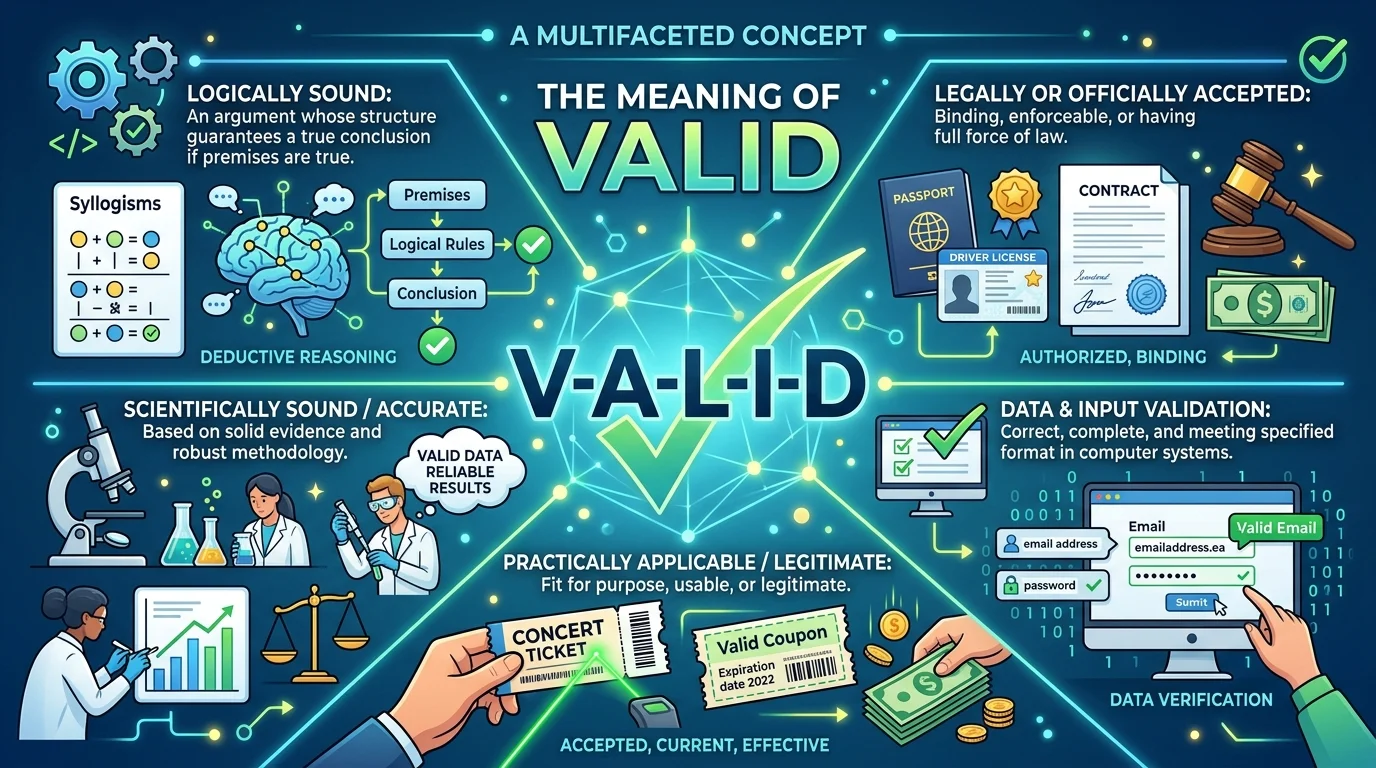
Valid generally means acceptable, true, reasonable, or officially recognized.
Core Meanings
Logically correct or sound
Legally or officially accepted
Reasonable and justified
Still active or usable
Example:
“That’s a valid reason for being late.”
Origin of the Word
Comes from Latin validus, meaning “strong,” “powerful,” or “effective.”
Entered English in the 16th century.
Originally described strength and effectiveness, later expanding to logic and legality.
How People Use “Valid Meaning” in Different Contexts
In Everyday Conversation
“Your feelings are valid.”
Means your emotions are real and justified.
“That argument isn’t valid.”
Means it doesn’t make sense or lacks proof.
In Logic and Reasoning
A valid argument is one where the conclusion logically follows from the premises.
It does not require the conclusion to be true, only logically consistent.
Example:
“If all birds fly, and a sparrow is a bird, then it flies.”
This structure is logically valid.
In Law and Official Use
“Valid ID” means an identification document that is current and legally accepted.
“Valid contract” means an agreement that meets legal requirements.
Example:
“Your passport must be valid for international travel.”
In Technology & Online Use
“Valid email address” means it’s formatted correctly and usable.
“Valid login” means credentials are recognized by the system.
Real-Life Examples
Example 1 (Emotional):
Sentence: “Your concerns about safety are valid.”
Explanation: Your worries make sense and deserve attention.
Example 2 (Legal):
Sentence: “The coupon is no longer valid.”
Explanation: It has expired or is no longer accepted.
Example 3 (Logic):
Sentence: “Her reasoning was valid, even if the outcome failed.”
Explanation: The logic was sound, despite the result.
Example 4 (Technical):
Sentence: “Please enter a valid phone number.”
Explanation: The number must meet system requirements.
Common Mistakes & Misunderstandings
Valid ≠ true: An argument can be valid but still false in reality.
Expired items aren’t valid: Cards, licenses, or offers lose validity over time.
Emotional validity matters: Saying feelings are valid doesn’t mean behavior is always justified.
Tip: Always look at context—logic, legality, emotions, or systems determine what “valid” means.
Related Words & Synonyms
Legitimate – officially accepted
Sound – logically correct
Reasonable – fair or sensible
Acceptable – meets requirements
Authentic – genuine or real
Internal Linking Opportunity:
Articles like legitimate meaning, reasonable meaning, or logical reasoning explained fit naturally here.